9 Best Dual Fuel Generators for RVs (November 2026)
The best dual fuel generators for RVs include the Westinghouse 5000 Peak Watt Super Quiet Dual for remote start and long runtime, the Champion 4000-Watt Dual Fuel RV Ready Portable for lightweight RV inverter power, and the WEN Quiet and Lightweight 3600-Watt Dual Fuel for quiet conversation-level camping.
On this page (10 sections)
- Best dual fuel generators for RVs: our top picks by load and weight
- Side-by-side comparison of RV dual fuel generators
- How we compared these dual fuel RV generators
- How many watts does a dual fuel generator for RV use need?
- Which RV outlet should a dual fuel generator have?
- Is propane or gasoline better for an RV dual fuel generator?
- How quiet should an RV generator be at a campground?
- Is a portable battery power station better for some RV trips?
- How should you set up and care for an RV dual fuel generator?
- Verdict: which dual fuel generator for RV use should you buy?
The best dual fuel generator for RV use is the Westinghouse 5000 Peak Watt Super Quiet Dual, because it pairs a TT-30R outlet with remote start and clean inverter power. Our score weighs specs, features and buyer feedback against what RV owners need on the road.
A dual fuel RV generator matters for two reasons. You can run on gasoline when a station is nearby, or switch to propane when you already have tanks on board.
That choice affects runtime, watts and how you refuel during a long trip.
Start with your RV outlet and your real loads. A 30A trailer, a 50A motorhome and a small teardrop do not need the same machine.
The picks below cover that range, from a 40.3 lb unit for light loads to an 8000W inverter for large rigs.
Our picks at a glance
-
1
 Best for remote start and long runtime
Westinghouse 5000 Peak Watt Super Quiet Dual
9.7/10 our score
See it on Amazon -
2
 Best for lightweight RV inverter power
Champion 4000-Watt Dual Fuel RV Ready Portable
9.7/10 our score
See it on Amazon -
3
 Best for quiet conversation-level camping
WEN Quiet and Lightweight 3600-Watt Dual Fuel
9.6/10 our score
See it on Amazon
- 4
 Check it
PowerSmart 3800 Watt Dual Fuel Inverter Generator
Best for quiet eco mode at 59 dBA - 5
 Check it
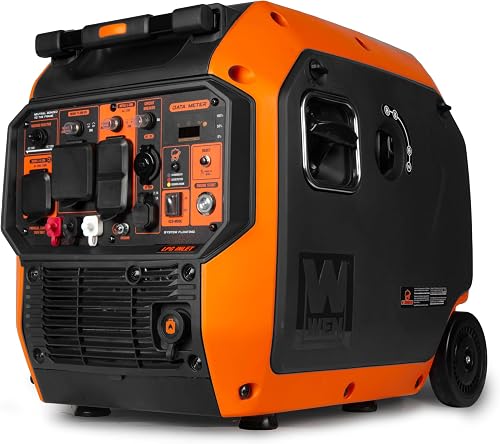
WEN 6800-Watt Dual Fuel RV-Ready Electric Start
Best for larger RV loads and 240V backup - 6
 Check it
Westinghouse 6500 Watt Dual Fuel Home Backup
Best for home backup with transfer switch ready outlet - 7
 Check it
BILT HARD Dual Fuel Gas & Propane
Best for enclosed quiet design at 58 dBA - 8
 Check it
AIVOLT 8000W Dual Fuel Inverter Generator 50A
Best for maximum watts and 50A RV power - 9
 Check it
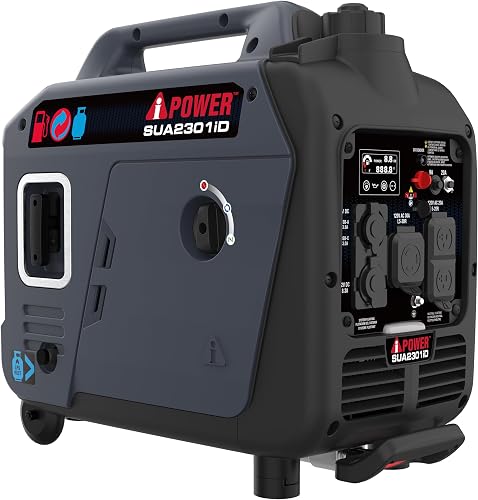
A-iPower 2300W Dual Fuel Inverter Generator
Best for small trailers and light loads
Best dual fuel generators for RVs: our top picks by load and weight
The best dual fuel generator for RV travel depends on your outlet, your air conditioner and how far you will carry the unit. Light inverters suit small trailers, while larger models suit bigger rigs and home backup.
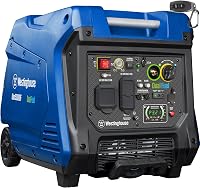
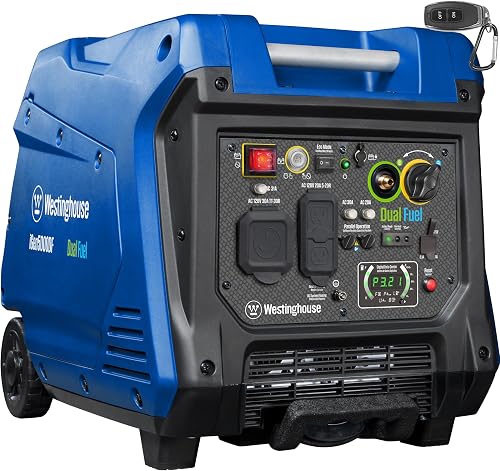
Westinghouse 5000 Peak Watt Super Quiet Dual: Best for remote start and long runtime
- 5000 peak watts and 3900 rated watts
- RV-ready TT-30R 30A outlet
- Up to 18 hours on a 3.4 gallon gas tank
- As low as 52 dBA
A quiet inverter with remote start, a data center and a 30A RV outlet for trailers that run air conditioning and everyday appliances.
Pros
- Remote start with key fob
- TT-30R 30A outlet
- Long gas runtime
Cons
- 104.7 lb weight
- Largest footprint among the lighter picks
The Westinghouse 5000 suits RVers who want remote start and a true 30A RV outlet. It delivers 5000 peak watts and 3900 rated watts with less than 3 percent THD for sensitive electronics.
A TT-30R 30A outlet connects to most travel trailer shore cords. Two USB outlets and a 5-20R duplex add options for phones, laptops and household plugs.
The LED data center shows fuel level, power output, remaining run time, voltage and lifetime hours. That display helps you plan refills instead of guessing.
Westinghouse rates noise as low as 52 dBA and runtime up to 18 hours on a 3.4 gallon gas tank. Economy mode lowers engine speed when your load is light.
The trade-off is weight and size at 104.7 lb and 24.5 by 16.3 by 20 inches. If you need a lighter unit, the Champion or WEN inverters below carry less power but move more easily.
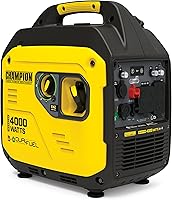
Champion 4000-Watt Dual Fuel RV Ready Portable: Best for lightweight RV inverter power
- 4000 starting watts and 3000 running watts on gas
- 2700 running watts on propane
- 51.8 lb weight
- 64 dBA from 23 feet
A light inverter that runs up to 10 hours on gas or 25 hours on a 20 lb propane tank at 25 percent load.
Pros
- Light at 51.8 lb
- Long propane runtime
- CO Shield auto shutoff
Cons
- Recoil start
- 25A TT-30R outlet rather than 30A
The Champion 4000-Watt suits RVers who want strong inverter power at a light weight. It weighs 51.8 lb and provides 4000 starting watts with 3000 running watts on gasoline.
On propane, it provides 2700 running watts and can run up to 25 hours on a 20 lb tank at 25 percent load. On gasoline, runtime is up to 10 hours at that same light load.
The outlet set includes a 120V 25A TT-30R, a 120V 20A duplex with less than 3 percent THD and a 12V automotive outlet. That mix covers RV shore power plus phones and accessories.
Champion rates noise at 64 dBA from 23 feet and includes CO Shield carbon monoxide auto shutoff. The optional parallel kit, sold separately, can connect another compatible Champion inverter.
The trade-off is recoil start and a 25A TT-30R outlet rather than 30A. If you want electric start and a 30A outlet, the Westinghouse 5000 is the closer match.
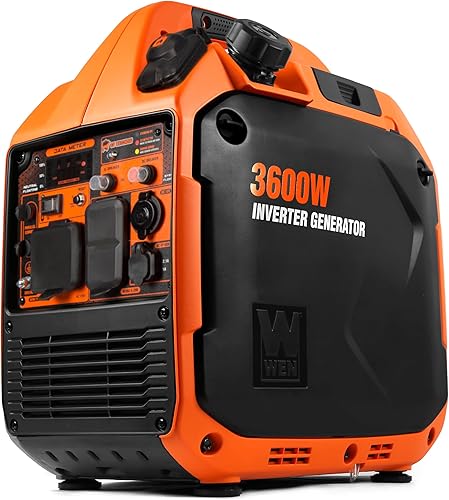
WEN Quiet and Lightweight 3600-Watt Dual Fuel: Best for quiet conversation-level camping
- 3600 surge watts and 2900 rated watts on gas
- 2600 rated watts on propane
- 49 lb weight
- 65 decibels at quarter load
A 49 lb inverter with fuel shutoff, CO Watchdog sensor and clean power for phones, tablets and laptops.
Pros
- Lightest inverter in this group
- Fuel shutoff helps maintenance
- CO Watchdog sensor
Cons
- Shorter gas runtime than larger tanks
- Lower watts on propane
The WEN 3600-Watt suits campers who value quiet operation and easy lifting. It weighs 49 lb and delivers 3600 surge watts with 2900 rated watts on gasoline.
On propane, output drops to 3500 surge watts and 2600 rated watts. That drop is normal for dual fuel models, so plan your heaviest loads for gasoline days.
The WEN Watchdog CO shutdown sensor turns the generator off if dangerous carbon monoxide levels are detected. Fuel shutoff lets the carburetor use up remaining fuel before shutdown, which helps limit maintenance.
Outlets include two 120V three-prong receptacles, one TT-30R RV receptacle, one 12V DC receptacle and two 5V USB ports. A tool-free LPG quick-connector makes propane hookup faster.
The trade-off is runtime and power compared with larger tanks. If you need longer runtime or higher rated watts for air conditioning, step up to the Westinghouse or WEN 6800 models.
PowerSmart 3800 Watt Dual Fuel Inverter Generator: Best for quiet eco mode at 59 dBA
- 3800 starting watts and 3300 running watts on gas
- 3100 running watts on propane
- 59 dBA at 25 percent load in Eco Mode
- Up to 24 hours on a 20 lb propane tank
A 50.7 lb inverter with a 30A twist-lock outlet, CO sensor and parallel-ready design for added power.
Pros
- Very quiet in Eco Mode
- Long propane runtime
- Parallel ready
Cons
- 1.3 gallon gas tank
- Uses L5-30R rather than TT-30R
The PowerSmart 3800 Watt suits RVers who want quiet eco mode and parallel-ready expansion. It delivers 3800 starting watts and 3300 running watts on gasoline and 3100 running watts on propane.
PowerSmart rates noise at 59 dBA at 25 percent load in Eco Mode. That rating makes it a strong candidate for campgrounds where generators must stay quiet.
Runtime is up to 8 hours at 25 percent load on a 1.3 gallon gas tank, or up to 24 hours on a standard 20 lb propane tank. Eco mode can extend runtime further when your load is light.
The control panel has a 120V 30A L5-30R twist-lock outlet, a 120V 20A duplex, a 12V 8A DC port and dual USB ports. Safety features include overload, short circuit, carbon monoxide sensor and low oil shutdown.
The trade-off is the L5-30R outlet, which may need an adapter for TT-30R RV cords. If direct TT-30R connection matters most, the Champion or Westinghouse picks fit better.
WEN 6800-Watt Dual Fuel RV-Ready Electric Start: Best for larger RV loads and 240V backup
- 6800 surge watts and 5100 rated watts on gas
- 4500 rated watts on propane
- TT-30R RV receptacle
- 240V bonded-neutral configuration
A larger inverter for air conditioning, electric vehicle backup and home essentials, with electric start and fuel shutoff.
Pros
- Highest rated watts on gas in its class here
- Electric start
- 120V and 240V outlets
Cons
- 99.2 lb weight
- Less portable than the 49 to 52 lb inverters
The WEN 6800-Watt suits larger RVs and owners who also need home backup. It provides 6800 surge watts and 5100 rated watts on gasoline, plus 6000 surge and 4500 rated watts on propane.
A bonded-neutral 240V configuration supports low-power Level 2 charging for battery and hybrid electric vehicles. That feature sets it apart from the smaller 120V-only inverters here.
The outlet set includes an L14-30R 120V/240V receptacle, two 120V receptacles, one TT-30R RV receptacle, one 12V DC receptacle and two USB ports. A voltage selector switch helps you match the load.
Keyless electric start with recoil backup makes starting easier, and fuel shutoff helps protect the carburetor during storage. The WEN Watchdog CO sensor adds automatic shutdown protection.
The trade-off is weight at 99.2 lb and a larger footprint. If you travel with a small trailer, the 49 to 52 lb inverters are easier to load and store.
Westinghouse 6500 Watt Dual Fuel Home Backup: Best for home backup with transfer switch ready outlet
- 6500 peak watts and 5300 running watts on gas
- 4800 running watts on propane
- 4.7 gallon fuel tank
- Up to 14.5 hours runtime
An open-frame generator with a transfer switch ready L14-30R outlet, CO sensor and a 120/240V selector for home or RV use.
Pros
- Transfer switch ready outlet
- Large gas tank
- 120/240V selector
Cons
- 135.6 lb weight
- Open frame design is less enclosed
The Westinghouse 6500 Watt suits owners who want home backup plus RV power in one machine. It delivers 5300 running watts and 6500 peak watts on gasoline, and 4800 running watts on propane.
A 4.7 gallon tank gives up to 14.5 hours of runtime, which is longer than the smaller inverter tanks here. A fuel gauge helps you check the level before a long night.
Outlets include one 5-20R household duplex, one TT-30R 30A RV receptacle and one L14-30R 30A transfer switch ready receptacle. That last outlet matters if you plan to feed household circuits during an outage.
The 274cc 4-stroke OHV engine has a cast iron sleeve, automatic low oil shutdown and a carbon monoxide sensor. Westinghouse backs it with 3-year limited service, labor and parts coverage.
The trade-off is weight at 135.6 lb and an open frame design. If portability and quiet enclosed operation matter more than transfer switch readiness, choose an inverter model instead.
BILT HARD Dual Fuel Gas & Propane: Best for enclosed quiet design at 58 dBA
- 4500 peak watts and 3500 rated watts on gas
- 3200 rated watts on propane
- 58 dBA at 23 feet
- Less than 3 percent THD
An enclosed inverter with ECO mode, CO sensor and parallel capability for campgrounds with noise rules.
Pros
- Quiet enclosed design
- Parallel capable
- TT-30R 30A outlet
Cons
- Recoil start
- 57.7 lb weight
The BILT HARD 4500W suits RVers who want an enclosed design for quiet campgrounds. It delivers 4500 peak watts and 3500 rated watts on gasoline, and 4150 peak with 3200 rated watts on propane.
BILT HARD rates noise at 58 dBA at 23 feet and says the enclosed design meets national park requirements. ECO mode adjusts engine speed to save fuel and lower sound.
Clean inverter power stays under 3 percent THD for sensitive electronics. Outlets include one 120V 20A duplex, one 120V 30A TT-30R outlet, dual USB ports and one 12V 8A DC output, all circuit breaker protected.
A CO sensor shuts the engine down during unsafe conditions, and an optional parallel kit, not included, can connect two units to double power. The 141cc OHV engine uses a propane hose with regulator.
The trade-off is recoil start and a 57.7 lb weight. If you want electric start, the Westinghouse 5000 or WEN 6800 models start at a button press.
AIVOLT 8000W Dual Fuel Inverter Generator 50A: Best for maximum watts and 50A RV power
- 8000W surge power and 6100 running watts on gas
- 5500 running watts on LPG
- 62 dBA from 23 feet
- Over 10 hours at 25 percent load
The largest inverter here for big RVs, job sites and emergency backup, with a 5-in-1 LCD display and electric start.
Pros
- Highest running watts here
- 50A RV focus
- Electric start
Cons
- 130.7 lb weight
- Largest size in this group
The AIVOLT 8000W suits big RVs, job sites and emergency backup needs. It delivers 8000W surge power and 6100 running watts on gasoline, and 7200 starting with 5500 running watts on LPG.
A 322cc 4-stroke OHV engine with 100 percent copper windings drives that output. Eco mode helps cut fuel use, with over 10 hours of runtime at 25 percent load.
AIVOLT rates noise at 62 dBA from 23 feet and uses a compact build with telescopic handle and two 7 inch never-flat wheels. The 5-in-1 LCD display shows fuel use, voltage, runtime and more.
Outlets include four outlets plus a 12V DC cigarette outlet and dual USB adapter. CO Alert technology shuts the unit down if unsafe carbon monoxide levels are detected, and electric start is included.
The trade-off is size and weight at 130.7 lb and 25.1 by 19.6 by 21.3 inches. If you need a lighter unit for a small trailer, the Champion or WEN inverters are far easier to carry.
A-iPower 2300W Dual Fuel Inverter Generator: Best for small trailers and light loads
- 2300 starting watts and 1800 running watts on gas
- 1600 running watts on propane
- 40.3 lb weight
- 61 dB sound level
A compact 40.3 lb inverter for lights, fans, phones and small appliances, with parallel cable and a 30A RV adapter included.
Pros
- Lightest option here
- Parallel cable included
- 30A RV adapter included
Cons
- Lowest watts in this group
- Not suited to air conditioning
The A-iPower 2300W suits small trailers, teardrops and light camping loads. It provides 2300 starting watts and 1800 running watts on gas, and 2000 starting with 1600 running watts on propane.
At 40.3 lb, it is the lightest model in this guide. A telescoping handle and flat free wheels help you move it from the truck to the campsite.
Inverter technology provides 3 percent THD clean power for laptops, TVs and phone chargers. The control panel has a CO sensor indicator light, LED light, data center display, two USB ports, one 12V DC outlet, one L5-30R 30A outlet and one duplex.
Included items include oil, funnel, tool kit, 30A RV adapter, 12V DC charging cables, parallel cable, manual, quick start guide and LPG hose with regulator. That bundle reduces extra purchases.
The trade-off is power. It will not run an RV air conditioner plus other heavy loads.
If you need more watts, step up to a 3600 to 4000 watt inverter model.
Side-by-side comparison of RV dual fuel generators
Our comparison table shows peak watts, rated watts, RV outlet type, weight and noise so you can match a model to your rig. No single model wins on every measure.
| Product | Best for | Peak watts | Rated watts | RV outlet | Our score |
|---|---|---|---|---|---|
| Westinghouse 5000 Peak Watt Super Quiet Dual | remote start and long runtime | 5000 | 3900 | TT-30R 30A | 9.7 |
| Champion 4000-Watt Dual Fuel RV Ready Portable | lightweight RV inverter power | 120V 25A TT-30R | 9.7 | ||
| WEN Quiet and Lightweight 3600-Watt Dual Fuel | quiet conversation-level camping | 2900 on gas | TT-30R | 9.6 | |
| PowerSmart 3800 Watt Dual Fuel Inverter Generator | quiet eco mode at 59 dBA | 120V 30A L5-30R | 9.5 | ||
| WEN 6800-Watt Dual Fuel RV-Ready Electric Start | larger RV loads and 240V backup | 5100 on gas | TT-30R | 9.4 | |
| Westinghouse 6500 Watt Dual Fuel Home Backup | home backup with transfer switch ready outlet | 6500 on gas | TT-30R 30A | 9.3 | |
| BILT HARD Dual Fuel Gas & Propane | enclosed quiet design at 58 dBA | 4500 on gas | 3500 on gas | TT-30R 30A | 9.1 |
| AIVOLT 8000W Dual Fuel Inverter Generator 50A | maximum watts and 50A RV power | 50A | 8.8 | ||
| A-iPower 2300W Dual Fuel Inverter Generator | small trailers and light loads | L5-30R 30A 120V | 8.1 |
How we compared these dual fuel RV generators
We compared specs, features and buyer feedback against what RV owners actually need. We checked outlet types first, because a TT-30R cord must match your RV inlet.
We then checked running watts, not just peak watts. Running watts tell you what you can use all day, while peak watts cover brief motor surges.
We also weighed noise, runtime, fuel choice and weight. Propane runtime matters for RVers who carry tanks, and weight matters when you load the generator into storage.
Our score favors RV-ready outlets, clean power under 3 percent THD, CO sensors and practical runtime. Larger open-frame models score lower for portability even when they have high watts.
How many watts does a dual fuel generator for RV use need?
A dual fuel generator for RV use needs enough running watts for your combined loads, plus enough starting watts for motors. Add the running watts for items you will run together, then check the air conditioner nameplate for starting demand.
Small trailers often run lights, fans, phones and a fridge on 1800 to 3000 running watts. That range fits the A-iPower 2300W, WEN 3600-Watt and Champion 4000-Watt picks.
Larger travel trailers with air conditioning often need 3900 to 5100 running watts. The Westinghouse 5000 and WEN 6800-Watt fit that group, while the AIVOLT 8000W covers even larger loads.
If you are unsure, our best dual fuel generator guide explains how peak and rated watts differ across generator types. That guide helps you read the numbers before you narrow the list.
What starting watts mean for air conditioning
Starting watts cover the brief surge when a motor starts. An air conditioner can need far more power for a second than it uses to keep running.
Check the air conditioner label and add the running watts for other items, such as a fridge or water pump. If the total passes the rated watts, the generator can overload.
For that reason, small inverters are a poor match for roof air conditioners. Choose a model with higher rated watts and test it with only the air conditioner first.
Which RV outlet should a dual fuel generator have?
Most 30A travel trailers use a TT-30R outlet, so that outlet gives the simplest connection. A TT-30R generator plugs straight into many RV shore power cords.
An L5-30R twist-lock outlet is common on inverters, but it often needs an adapter for TT-30R cords. The PowerSmart and A-iPower models use L5-30R, so check whether an adapter is included or needed.
A 50A RV needs a generator built for 50A service or a transfer arrangement matched to your rig. The AIVOLT 8000W is built around 50A RV power, while smaller models are meant for 30A or light loads.
If you want a broader view of inverter models, see our best dual fuel inverter generator picks. Those models focus on clean power for electronics and quieter operation.
How to check your RV power inlet
Look at the inlet on your RV and match the plug shape on your shore cord. The plug shape tells you whether you need TT-30R, L5-30R or a 50A connector.
Count your breakers and check the amp rating on your RV panel. A 30A panel and a 50A panel need different generator outputs and different cords.
Take a photo of the inlet and plug before you order. That photo prevents a mismatch that an adapter may or may not solve.
Is propane or gasoline better for an RV dual fuel generator?
Propane is better for storage and cleaner burning, and many RVers already carry propane tanks. It also avoids stale gasoline in the carburetor during long storage periods.
Gasoline is better for maximum watts and wide availability on road trips. Every model here lists higher running watts on gasoline than on propane.
Runtime can favor propane at light load. The Champion runs up to 25 hours on a 20 lb propane tank at 25 percent load, and the PowerSmart runs up to 24 hours on propane.
Choose the fuel you can refill on your route. If you pass stations often, gasoline is simple.
If you camp off grid with propane tanks, propane may be simpler.
For lighter camping loads, our best small dual fuel generator list covers compact models that still run on both fuels. Those models suit tents and small trailers where storage space is tight.
How dual fuel switching works in daily use
Most models use a fuel selector or an LPG hose to switch between gas and propane. You connect the hose, open the tank valve and select the fuel before starting.
Never switch fuels while the engine is running unless the maker says you can. Stop the unit, let it cool and follow the manual steps.
Propane output is lower, so move heavy loads to gasoline when you need full watts. Keep a charged phone and a flashlight nearby for the first setup.
How quiet should an RV generator be at a campground?
An RV generator should be as quiet as you can afford, because campground rules often limit noise and hours. Ratings near 52 to 59 dBA are the quietest in this group.
The Westinghouse 5000 is rated as low as 52 dBA, the BILT HARD is rated at 58 dBA and the PowerSmart is rated at 59 dBA in Eco Mode. Those numbers help in crowded sites.
Check how each brand measured noise, since some use 23 feet and some use quarter load. A rating at 23 feet is easier to compare across models.
Distance still matters more than a small rating gap. A generator 30 feet away sounds much quieter than the same unit beside your RV door.
If you camp near tents more than RVs, see our best dual fuel generator for camping guide for quieter and lighter options. That list helps when you carry the unit by hand.
What eco mode and economy mode do
Eco mode and economy mode lower engine speed when your load is light. That lowers noise and fuel use at the same time.
Use eco mode for lights, fans and phone charging. Turn it off when you start an air conditioner or a motor load that needs full power.
If the generator stumbles when a large load starts, switch eco mode off and start the heavy load first. Add smaller loads one at a time.
Is a portable battery power station better for some RV trips?
A portable battery power station is better for short, silent loads such as lights, phones and a CPAP machine. It needs no fuel and makes no exhaust while it runs.
It is worse for air conditioning, electric heaters and long trips without recharge. A fuel generator can run for hours and refuel anywhere, while a battery must be recharged.
Some RVers use both. The battery runs quiet loads at night, and the generator runs heavy loads or recharges the battery during the day.
If you want that option, our best portable battery power station guide compares capacities and outlets. Use it to size a battery for the loads you run after dark.
How to size a battery for overnight RV loads
Add the watts for lights, chargers and medical devices you will run overnight. Then check how many watt-hours the battery provides at that load.
A small battery can run phones and LED lights for many hours. It will drain fast if you add a television or a fan for the whole night.
Fuel generators still win for multi-day boondocking. A battery is best as a quiet supplement, not as a full replacement for a large RV load.
How should you set up and care for an RV dual fuel generator?
Set up the generator on level ground outdoors, away from windows and vents. Carbon monoxide can build up near openings, so keep exhaust pointed away from the RV.
Add oil before the first start and check the level before each trip. Low oil shutdown protects the engine, but it does not replace regular checks.
Connect the RV cord with the generator off, then start the engine and add loads one at a time. Start motor loads first, then add lights and electronics.
For storage, use fuel shutoff when the model has it, or follow the manual steps to run the carburetor dry. That step helps prevent stale fuel blockages.
Store the unit upright in a dry place and keep the manual with it. Check the oil, air filter and spark plug on the schedule in the manual for your model.
Verdict: which dual fuel generator for RV use should you buy?
The best dual fuel generator for RV use is the Westinghouse 5000 Peak Watt Super Quiet Dual for most 30A trailers, because it has remote start, a TT-30R outlet and 3900 rated watts.
Pick the Champion 4000-Watt if weight matters more than electric start. It weighs 51.8 lb and runs a long time on propane at light load.
Pick the WEN 6800-Watt if you need higher watts or 240V backup. It has 5100 rated watts on gas and a TT-30R outlet for RV use.
Pick the A-iPower 2300W if you have a small trailer with light loads. It is the lightest here at 40.3 lb, but it cannot run an air conditioner with other loads.
Match the outlet first, then match the watts to your loads, then check weight and noise. That order will point you to the right dual fuel RV generator for your rig.
Our top 3 picks at a glance
-
1
Best for remote start and long runtime
Westinghouse 5000 Peak Watt Super Quiet Dual
9.7/10 our score
See it on Amazon -
2
Best for lightweight RV inverter power
Champion 4000-Watt Dual Fuel RV Ready Portable
9.7/10 our score
See it on Amazon -
3
Best for quiet conversation-level camping
WEN Quiet and Lightweight 3600-Watt Dual Fuel
9.6/10 our score
See it on Amazon
Frequently asked questions
What size dual fuel generator do I need for an RV?
Add the running watts for items you will use together, then add starting watts for motors such as air conditioning. A 30A RV needs a generator that can supply your combined load without overload.
Small trailers often work with 1800 to 3000 running watts.
Larger rigs with air conditioning often need 3900 to 5100 running watts or more, so check your RV amp rating and appliance labels first.
Is propane or gasoline better for an RV generator?
Propane burns cleaner and stores well, and many RVers already carry propane tanks. Gasoline is widely available and most models here produce more watts on gas.
Propane runtime can be much longer at light load, but running watts drop on every dual fuel model in this guide.
Choose the fuel you can refill easily on your route.
Do I need a TT-30R outlet or an L5-30R outlet?
A TT-30R outlet matches most 30A RV shore power cords directly. An L5-30R twist-lock outlet needs an adapter for many RV cords, and that adapter is not always included.
If your cord uses TT-30R, a generator with that outlet saves space and cost.
Check your RV power inlet before you order.
Can a dual fuel generator run an RV air conditioner?
Some can, if the running watts cover the air conditioner plus other loads and the starting watts cover the motor surge. The Westinghouse 5000, WEN 6800 and AIVOLT 8000W have the higher ratings for this job.
Smaller models such as the A-iPower 2300W are better for lights and electronics.
Always check the air conditioner nameplate and add other loads.
How quiet should an RV generator be for campgrounds?
Look for a rating near 52 to 65 dBA and check how the brand measured it, since some use 23 feet and some use quarter load. The Westinghouse 5000 is rated as low as 52 dBA, and the PowerSmart and BILT HARD are near 58 to 59 dBA.
Lower numbers help at crowded campgrounds, but distance and wind still matter.