9 Best Dual Fuel Inverter Generators (November 2026)
The best dual fuel inverter generators include the Westinghouse 5000 Peak Watt Super Quiet Dual for home backup and RV use, the Champion 4000-Watt Dual Fuel RV Ready Portable for light portable inverter power, and the WEN Quiet and Lightweight 3600-Watt Dual Fuel for quiet camping with electronics.
On this page (19 sections)
- Our top dual fuel inverter generator picks, ranked by score
- Westinghouse 5000 Peak Watt Super Quiet Dual
- Champion 4000-Watt Dual Fuel RV Ready Portable
- WEN Quiet and Lightweight 3600-Watt Dual Fuel
- WEN 6800-Watt Dual Fuel RV-Ready Electric Start
- PowerSmart 4400 Watt Dual Fuel Portable Generator
- AIVOLT 8000W Dual Fuel Inverter Generator 50A
- BILT HARD 5500W Dual Fuel Inverter Generator
- Pulsar
- PowerSmart 3800 Watt Dual Fuel Inverter Generator
- Dual fuel inverter generator comparison: watts, weight and runtime
- How we compared these dual fuel inverter generators
- What size dual fuel inverter generator do you need?
- Gasoline or propane: which fuel should you choose?
- How quiet should a dual fuel inverter generator be?
- Which outlets and safety features matter most?
- Electric start, remote start or recoil start: what to pick?
- How to set up and care for a dual fuel inverter generator?
- Verdict: which dual fuel inverter generator should you buy?
The best dual fuel inverter generator for most buyers is the Westinghouse 5000 Peak Watt Super Quiet Dual. It pairs 3900 rated watts with remote start, RV-ready outlets and long gas runtime.
Our score weighs specs, features and buyer feedback against what you are shopping for.
A dual fuel inverter generator gives you fuel choice plus clean inverter output for sensitive electronics and refrigeration. That matters when a power outage hits your freezer, fridge, phones and medical basics at the same time.
If you want a broader view first, start with our best dual fuel generator guide. For battery-only backup, see best portable battery power station.
Our picks at a glance
-
1
 Best for home backup and RV use
Westinghouse 5000 Peak Watt Super Quiet Dual
9.7/10 our score
See it on Amazon -
2
 Best for light portable inverter power
Champion 4000-Watt Dual Fuel RV Ready Portable
9.7/10 our score
See it on Amazon -
3
 Best for quiet camping with electronics
WEN Quiet and Lightweight 3600-Watt Dual Fuel
9.6/10 our score
See it on Amazon
- 4
 Check it
WEN 6800-Watt Dual Fuel RV-Ready Electric Start
Best for 240V and EV backup power - 5
 Check it
PowerSmart 4400 Watt Dual Fuel Portable Generator
Best for fridges and household basics - 6
 Check it
AIVOLT 8000W Dual Fuel Inverter Generator 50A
Best for high-output RV and job site use - 7
 Check it
BILT HARD 5500W Dual Fuel Inverter Generator
Best for parallel-ready home backup - 8
 Best for small portable backupCheck it
- 9
 Check it
PowerSmart 3800 Watt Dual Fuel Inverter Generator
Best for quiet home emergency use
Our top dual fuel inverter generator picks, ranked by score
The Westinghouse and Champion 4000-Watt models tie on score for different reasons. Westinghouse wins on output and remote start.
Champion wins on weight and propane runtime.
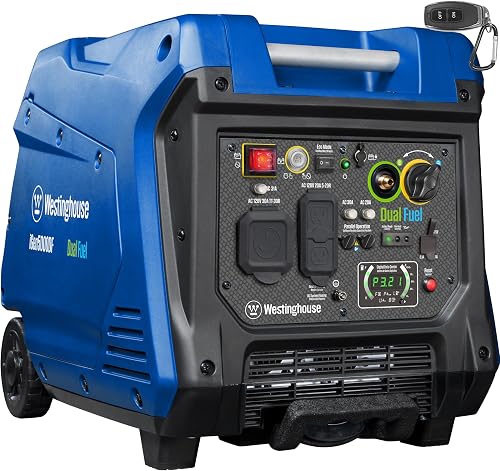
Westinghouse 5000 Peak Watt Super Quiet Dual
Westinghouse 5000 Peak Watt Super Quiet Dual: Best for home backup and RV use
- 5000 peak watts and 3900 rated watts
- Less than 3% THD
- Remote electric start with key fob
- As low as 52 dBA
- Up to 18 hour run time on 3.4 gallon gas tank
Strong rated output with remote start and RV-ready outlets for home essentials and travel trailers.
Pros
- Remote start with included key fob
- TT-30R 30 amp outlet and household duplex
- LED display with fuel and runtime
Cons
- Heavier than the 4000-watt picks
- Larger footprint for small storage spaces
The Westinghouse suits home backup and travel trailer use where you want one unit to handle essentials without a lot of fuss. It delivers 5000 peak watts and 3900 rated watts at less than 3% THD, which is clean enough for sensitive electronics.
That clean output suits TVs, laptops, tablets and mobile devices in daily use. Remote start with the included key fob is a real benefit during storms or overnight outages.
You can start it from a distance rather than walking out in bad weather. It also has electric and recoil start as backup if the battery or fob is not ready.
Outlets include a 5-20R 120V duplex, an RV-ready TT-30R 30 amp outlet and two USB outlets. The LED data center rotates through fuel level, power output, remaining run time, voltage and lifetime hours.
Westinghouse lists as low as 52 dBA and up to 18 hours on a 3.4 gallon gas tank. Economy mode helps fuel use at light loads.
The trade-off is weight at 104.7 pounds and a larger footprint than the 4000-watt picks.
Champion 4000-Watt Dual Fuel RV Ready Portable
Champion 4000-Watt Dual Fuel RV Ready Portable: Best for light portable inverter power
- 4000 starting watts and 3000 running watts on gasoline
- 2700 running watts on propane
- 64 dBA from 23 feet
- Up to 10 hours on gasoline and 25 hours on propane
- 51.8 pounds
A light RV-ready inverter with CO Shield and long propane runtime for camping and backup basics.
Pros
- Under 55 pounds
- CO Shield carbon monoxide auto shutoff
- Parallel ready with optional kit
Cons
- Recoil start only
- Lower running watts on propane
This Champion suits camping, tailgating and RV backup where carrying weight matters. It weighs 51.8 pounds and is one of the lightest 4000-watt inverters in this group, so you can move it from a truck to a campsite without a lot of strain.
It gives 4000 starting watts and 3000 running watts on gasoline. On propane it gives 4000 starting watts and 2700 running watts, so gasoline is the stronger choice for larger motor loads.
Runtime reaches up to 10 hours on gasoline and 25 hours on a 20-pound propane tank at 25% load. That propane figure is a clear advantage for overnight camping or long outages.
Champion lists 64 dBA from 23 feet and clean electricity at less than 3% THD. Outlets include a TT-30R, a household duplex, a 12V automotive outlet and parallel outlets.
Cold Start Technology helps in cold weather.
The trade-off is recoil start only, plus an optional parallel kit sold separately. For brand depth, read our best champion inverter generator dual fuel guide.
WEN Quiet and Lightweight 3600-Watt Dual Fuel
WEN Quiet and Lightweight 3600-Watt Dual Fuel: Best for quiet camping with electronics
- 3600 surge watts and 2900 rated watts on gasoline
- 3500 surge watts and 2600 rated watts on propane
- 65 decibels at quarter load
- 49 pounds
- THD under 0.3 percent at no load and under 1.2 percent at full load
Quiet and light with clean power for laptops and phones, plus a CO watchdog and fuel shutoff.
Pros
- Lightest full pick here at 49 pounds
- Fuel shutoff helps limit maintenance
- TT-30R RV receptacle included
Cons
- Shorter runtime than larger tanks
- Lower output for larger home loads
The WEN DF360iX suits quiet camping and home backup for electronics. It weighs 49 pounds and runs at 65 decibels at quarter load, which WEN describes as comparable to normal conversation.
It gives 3600 surge watts and 2900 rated watts on gasoline. On propane it gives 3500 surge watts and 2600 rated watts, so you lose a little output when you switch fuels.
The 149cc engine and 1.5 gallon tank give up to 5 hours at half load. That runtime suits a weekend trip or evening backup better than a multi-day outage.
Clean power is a strength here. WEN limits THD to under 0.3 percent at no load and under 1.2 percent at full load.
That suits laptops, phones, tablets and monitors without extra conditioning.
The WEN Watchdog CO shutdown sensor adds safety. Fuel shutoff helps use up carburetor fuel before shutdown to limit maintenance.
The trade-off is lower output than the 5000-watt class.
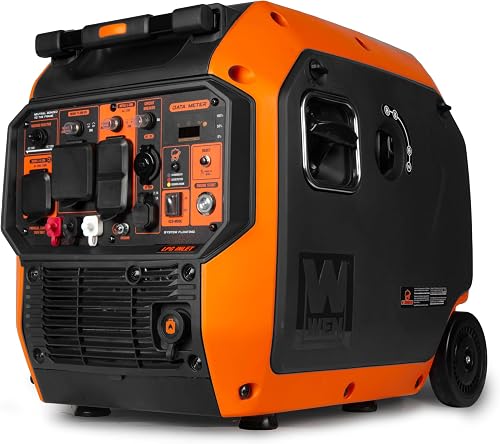
WEN 6800-Watt Dual Fuel RV-Ready Electric Start
WEN 6800-Watt Dual Fuel RV-Ready Electric Start: Best for 240V and EV backup power
- 6800 surge watts and 5100 rated watts on gasoline
- 6000 surge watts and 4500 rated watts on propane
- Bonded-neutral 240V configuration
- Electric start
- 64 decibels at quarter load
High output with 120V/240V outlets for RVs, home backup and low-power Level 2 EV charging.
Pros
- 240V L14-30R receptacle
- Electric start with recoil backup
- Wheels and telescoping handle
Cons
- Near 100 pounds
- Propane output drops to 4500 rated watts
This larger WEN suits buyers who need 240V power or EV backup. It gives 6800 surge watts and 5100 rated watts on gasoline, the second highest gasoline rated output in this group.
On propane it gives 6000 surge watts and 4500 rated watts. The 224cc engine supports that output while keeping the design in a wheeled, portable frame.
The bonded-neutral 240V configuration supports low-power Level 2 charging for battery and hybrid electric vehicles. That is a rare feature in this group and a strong reason to consider it for driveway backup.
It has electric start with recoil backup, wheels and a telescoping handle. WEN lists 64 decibels at quarter load and very low THD for sensitive electronics.
Outlets include an L14-30R 120V/240V receptacle, two 120V receptacles, a TT-30R, a 12V DC receptacle and USB ports. The trade-off is 99.2 pounds of weight.
PowerSmart 4400 Watt Dual Fuel Portable Generator
PowerSmart 4400 Watt Dual Fuel Portable Generator: Best for fridges and household basics
- 4400 starting and 3600 running watts on gasoline
- 4000 starting and 3300 running watts on LPG
- Less than 3% THD
- 8 hour runtime at 25% load on gasoline
- 24 hour runtime on 20 lb propane tank at 25% load
Mid-size inverter tech for fridges, TVs and household appliances during blackouts.
Pros
- Strong running watts for its size
- Eco-mode control panel
- Parallel ready
Cons
- Noise rating is higher than quiet picks
- 2-year limited warranty
The PowerSmart 4400 Watt suits emergency blackouts where a fridge is the priority. It delivers 4400 starting and 3600 running watts on gasoline, which puts it ahead of several 4000-watt class picks for sustained loads.
On LPG it delivers 4000 starting and 3300 running watts. That running output can supply fridges, TVs and other household appliances during an outage.
Inverter technology gives clean power at less than 3% THD for phones, tablets and cameras. The 223cc OHV 4-stroke engine is listed as the source of that stable output.
Runtime is strong for the size. The 1.6 gallon gasoline tank gives 8 hours at 25% load.
A standard 20 lb propane tank gives 24 hours at 25% load, which helps overnight use.
The control panel has a 120V 30A twist-lock outlet, a 120V 20A duplex, a 12V DC port and Eco-mode. It weighs 68 pounds.
The trade-off is a higher noise rating than the quietest picks.
AIVOLT 8000W Dual Fuel Inverter Generator 50A
AIVOLT 8000W Dual Fuel Inverter Generator 50A: Best for high-output RV and job site use
- 8000 surge watts and 6100 running watts
- 7200 starting watts and 5500 running watts on LPG
- 62 dBA from 23 feet
- Over 10 hours at 25% load
- 130.7 pounds
Highest running output here for RVs, job sites and emergency backup, with electric start.
Pros
- Highest running watts in this group
- 5-in-1 LCD display center
- Electric start and CO alert
Cons
- Heaviest pick here
- Lower buyer satisfaction than top picks
The AIVOLT 8000W suits RVs, job sites and larger emergency backup. It gives 8000 surge watts and 6100 running watts, the highest running output in this group on gasoline.
On LPG it gives 7200 starting watts and 5500 running watts. A 322cc 4-stroke OHV engine and 100% copper windings support that output for tools and larger appliances.
AIVOLT lists over 10 hours of runtime at 25% load in Eco-mode. That runtime matters because high-output units can use fuel quickly at higher loads.
It is library-quiet for its size at 62 dBA from 23 feet. The design has a telescopic handle and two 7 inch never-flat wheels to help with movement.
It weighs 130.7 pounds, so plan for vehicle loading and storage space. The 5-in-1 LCD display shows fuel use, voltage and runtime.
It has four outlets, a 12V DC outlet and dual USB.
The trade-off is size and weight for storage.
BILT HARD 5500W Dual Fuel Inverter Generator
BILT HARD 5500W Dual Fuel Inverter Generator: Best for parallel-ready home backup
- 5500 starting watts and 4000 running watts on gasoline
- 5000 starting watts and 3600 running watts on LPG
- 160CC OHV engine
- 1.14 gallon fuel tank
- 61.7 pounds
Compact dual fuel inverter with economy mode, digital display and parallel connectors.
Pros
- Light for its starting watts
- TT-30R RV outlet
- CO auto-shutoff and protections
Cons
- Small 1.14 gallon tank
- 90 day warranty description
The BILT HARD 5500W suits home backup, RV and camping use at a mid weight. It delivers 5500 starting watts and 4000 running watts on gasoline, which gives good headroom for motor starting.
On LPG it delivers 5000 starting watts and 3600 running watts. That drop is normal for dual fuel, but you should size your load list for the lower propane figure.
A 160CC OHV engine runs at 4850 RPM with forced-air cooling and recoil start. The 1.14 gallon tank supports practical portable operation, though it is small for long outages.
Economy mode lowers engine speed at light loads to reduce fuel use and noise. The digital display cycles through volts, frequency, amps, watts, runtime hours and fuel level.
Outlets include 120V 20A outlets, a TT-30R RV outlet, 12V DC output and USB-C/USB-A. It is parallel-ready and weighs 61.7 pounds.
The trade-off is the small tank.
Pulsar
Pulsar: Best for small portable backup
- 2200 peak watts and 1800 rated watts on gas
- 2000 peak watts and 1600 rated watts on LPG
- 60Db super quiet operation
- 1.18 gallon fuel tank
- 44 pounds
Small and quiet for camping, tailgating and sensitive electronics at a modest wattage.
Pros
- Lightest pick here
- Parallel capability
- CARB compliant
Cons
- Lowest output in this group
- Short LPG runtime on 1 pound tank
The Pulsar PG2200BiS suits small backup needs and outdoor adventures. It gives 2200 peak watts and 1800 rated watts on gas, which is the lowest output in this group but also the most portable.
On LPG it gives 2000 peak watts and 1600 rated watts. At 44 pounds, it is the lightest pick here and fits easily in a car trunk or small storage closet.
Super quiet operation at 60Db helps at campgrounds and tailgates. A compact carrying case design aids storage and transport between sites.
It has stable sine wave output for sensitive electronics and parallel capability for future expansion. Outlets include two 120V 15A AC outlets and a 5V USB outlet.
Runtime is 8 hours on a single tank of gas at half load. LPG runtime is 75 minutes on a 1 pound tank at half load, so gas is better for longer use.
The trade-off is low output for home essentials.
PowerSmart 3800 Watt Dual Fuel Inverter Generator
PowerSmart 3800 Watt Dual Fuel Inverter Generator: Best for quiet home emergency use
- 3800 starting watts and 3300 running watts on gasoline
- 3500 starting watts and 3100 running watts on propane
- 59 dBA at Eco Mode
- 8 hours at 25% load on 1.3 gallon tank
- 50.7 pounds
Quiet emergency pick with clean power, CO protection and long propane runtime.
Pros
- Very quiet at 59 dBA in Eco Mode
- Parallel ready
- Dual USB ports
Cons
- Recoil start
- Mid-range output for large loads
This PowerSmart suits quiet home emergency use at a light weight. It delivers 3800 starting watts and 3300 running watts on gasoline, which covers a fridge plus lights and phones.
On propane it delivers 3500 starting watts and 3100 running watts. It operates at just 59 dBA at Eco Mode.
That level will not disturb neighbors in many settings.
It weighs 50.7 pounds with a built-in handle, so moving it to a porch or campsite is manageable for one person.
Runtime reaches 8 hours at 25% load on its 1.3 gallon gas tank. A standard 20 lb propane tank gives up to 24 hours.
That long propane runtime is useful for overnight outages.
Outlets include a 120V 30A twist-lock, a 120V 20A duplex, a 12V DC port and dual USB ports. It is parallel ready and has CO protection.
The trade-off is recoil start.
Dual fuel inverter generator comparison: watts, weight and runtime
| Product | Best for | Peak Watts | Rated Watts | Weight | Our score |
|---|---|---|---|---|---|
| Westinghouse 5000 Peak Watt Super Quiet Dual | home backup and RV use | 5000 | 3900 | 104.7 pounds | 9.7 |
| Champion 4000-Watt Dual Fuel RV Ready Portable | light portable inverter power | 51.8 pounds | 9.7 | ||
| WEN Quiet and Lightweight 3600-Watt Dual Fuel | quiet camping with electronics | 2900 on gasoline | 49 pounds | 9.6 | |
| WEN 6800-Watt Dual Fuel RV-Ready Electric Start | 240V and EV backup power | 5100 on gasoline | 99.2 pounds | 9.4 | |
| PowerSmart 4400 Watt Dual Fuel Portable Generator | fridges and household basics | 68 pounds | 9.0 | ||
| AIVOLT 8000W Dual Fuel Inverter Generator 50A | high-output RV and job site use | 130.7 pounds | 8.8 | ||
| BILT HARD 5500W Dual Fuel Inverter Generator | parallel-ready home backup | 61.7 pounds | 8.8 | ||
| Pulsar | small portable backup | 2200 on gas | 1800 on gas | 44 pounds | 8.3 |
| PowerSmart 3800 Watt Dual Fuel Inverter Generator | quiet home emergency use | 50.7 pounds | 8.1 |
Use the table by your main limit first. If weight is your limit, start with Pulsar, WEN 3600-Watt and Champion.
If running watts are your limit, start with AIVOLT and WEN 6800-Watt.
How we compared these dual fuel inverter generators
We compared specs, features and buyer feedback against what a dual fuel inverter searcher wants. We checked rated watts, peak watts, fuel runtime, decibel ratings, THD, outlets, start type and weight.
We did not test these units. Maker claims are labeled by brand, and buyer patterns are attributed without inventing results.
Our score reflects fit for home backup, RV use and camping. A model can score lower here if it is heavy, short on runtime or weak on outlets for this use.
What specs matter most in daily use
Rated watts matter more than peak watts for daily planning. Rated watts tell you what you can run together for hours without overload.
Runtime at a stated load matters next. An 8 hour figure at 25% load is not the same as 8 hours at half load, so check the load percentage before you compare tanks.
Weight and start type shape whether you will actually use the unit. A 130 pound model needs wheels and a ramp, while a 50 pound model can go in a trunk.
Noise and THD matter for campsites and electronics. A low decibel rating helps shared spaces, and low THD protects laptops and TVs.
What size dual fuel inverter generator do you need?
Start with running watts, not peak watts. Running watts are what the generator can supply all day.
Peak watts only help for short motor starts.
Small loads: phones, lights and a fridge
A 2200 to 3600 watt inverter fits phones, lights, laptops and one fridge. Pulsar and WEN 3600-Watt fit this range.
Medium loads: fridge plus home basics
A 3800 to 4400 watt inverter fits a fridge, TV, lights and fans together. PowerSmart models and Champion fit this range well.
Large loads: RV plus home essentials
A 5000 watt or larger inverter fits more simultaneous loads. Westinghouse, WEN 6800-Watt and AIVOLT fit this range.
Gasoline or propane: which fuel should you choose?
Gasoline gives more watts. Propane gives long storage and long runtime.
Many buyers choose dual fuel to avoid being stuck with one fuel type.
Choose gasoline for maximum output
Westinghouse gives 3900 rated watts on gas. WEN 6800-Watt gives 5100 rated watts on gas.
Use gas when you need every watt.
Choose propane for long runtime
Champion gives up to 25 hours on a 20 lb propane tank. PowerSmart 4400 Watt gives 24 hours on propane at 25% load.
Mix fuels during an outage
Dual fuel models let you switch when one fuel runs low. That flexibility helps during fuel shortages and evacuations.
Our best dual fuel generator with electric start guide covers start options.
How quiet should a dual fuel inverter generator be?
Aim for 65 dBA or less for camping and neighborhood use. Decibel ratings are not all measured the same way, so compare the stated distance and load.
Quietest picks for shared spaces
Westinghouse lists as low as 52 dBA. PowerSmart 3800 Watt lists 59 dBA at Eco Mode.
AIVOLT lists 62 dBA from 23 feet.
Mid-range picks for campsites
Champion lists 64 dBA from 23 feet. WEN models list 64 to 65 decibels at quarter load.
These levels suit many campgrounds with smart placement.
Placement still matters
Run the unit outdoors with exhaust away from doors and windows. Keep it downwind and away from sleeping areas.
Never run it in a garage or enclosed space.
Which outlets and safety features matter most?
Match outlets to your RV, home cords and DC devices first. Then check CO shutoff, low oil shutdown and overload protection.
RV-ready outlets
Westinghouse, Champion, WEN and BILT HARD include TT-30R outlets. That plug fits many travel trailers.
Our best dual fuel generator for rv guide covers RV-focused picks.
Clean power for electronics
Look for inverter tech with low THD. Westinghouse and Champion list less than 3% THD.
WEN lists under 1.2 percent at full load.
CO and overload protection
Champion has CO Shield. WEN has Watchdog CO shutdown.
PowerSmart has CO Protect.
AIVOLT has CO Alert. These features add a safety layer, not a substitute for outdoor use.
Parallel capability
Westinghouse, Champion, PowerSmart and Pulsar support parallel use in some form. Parallel kits or second units are often sold separately.
Check kit compatibility before you buy.
Electric start, remote start or recoil start: what to pick?
Electric start is worth it if you will start the unit often or in bad weather. Remote start is a step above for home backup.
Remote start for home backup
Westinghouse includes remote start with a key fob. You can start it without walking to the unit.
That helps during storms and overnight outages.
Electric start for RV and job site use
WEN 6800-Watt has keyless electric start with recoil backup. AIVOLT has electric start.
Electric start saves pulling a recoil cord repeatedly.
Recoil start for light weekend use
Champion, BILT HARD, Pulsar and PowerSmart 3800 Watt use recoil start. Recoil is simple and light, but less convenient in cold or wet weather.
For Champion-specific models, see our best champion dual fuel generator guide and champion inverter generator 2500 comparison.
How to set up and care for a dual fuel inverter generator?
Set it up outdoors, check oil first, then add fuel and start with no load connected. That order protects the engine and the devices you plan to plug in.
First setup steps
Add the recommended oil before first start. Connect gasoline or a propane tank with the included hose.
Turn on the fuel valve and start the engine with loads disconnected.
Daily use habits
Use Eco-mode or Economy mode at light loads to save fuel. Check fuel level and runtime on the display before you need power.
Add loads one at a time.
Storage care in general terms
Use fuel shutoff when your model has it to help protect the carburetor. Run the engine periodically as the manual directs.
Store propane tanks upright and away from heat.
Brand-specific depth
WEN buyers should also read our best wen dual fuel generator guide. Champion buyers should read the Champion guides linked above for model detail.
Verdict: which dual fuel inverter generator should you buy?
Buy the Westinghouse if you want the best all-around home backup and RV pick. It has the best mix of rated watts, remote start, quiet operation and long runtime here.
Buy the Champion 4000-Watt if weight matters most. At 51.8 pounds it is far easier to carry than the 5000-watt class.
Propane runtime is a major plus.
Buy the WEN 6800-Watt if you need 240V power. Its L14-30R outlet and EV charging support set it apart from every other pick here.
Buy the Pulsar if you need small and light backup. It will not run a whole home, but it handles camping essentials and sensitive electronics well.
Revisit your load list before you order. Then pick the best dual fuel inverter generator that covers your running watts, fits your storage space and matches the fuel you can actually get during an outage.
Our top 3 picks at a glance
-
1
Best for home backup and RV use
Westinghouse 5000 Peak Watt Super Quiet Dual
9.7/10 our score
See it on Amazon -
2
Best for light portable inverter power
Champion 4000-Watt Dual Fuel RV Ready Portable
9.7/10 our score
See it on Amazon -
3
Best for quiet camping with electronics
WEN Quiet and Lightweight 3600-Watt Dual Fuel
9.6/10 our score
See it on Amazon
Frequently asked questions
What size dual fuel inverter generator do I need?
Add the running watts for the items you will use together, then check starting watts for motors. A fridge, lights and phones often fit a 3000 to 4000 watt inverter.
Larger home loads or 240V tools need 5000 watts or more.
Is inverter power safe for electronics?
Inverter generators here make clean power with low THD for sensitive electronics. Westinghouse and Champion list less than 3% THD.
WEN lists under 1.2 percent at full load.
Still check each device maker for portable power guidance.
Gasoline or propane, which fuel is better?
Gasoline usually gives more watts and faster refueling. Propane often gives longer runtime on a 20 lb tank and stores cleanly for emergencies.
Dual fuel models let you switch based on what fuel you have available.
Can I run a fridge on a dual fuel inverter generator?
Many buyers run a fridge on 3000 watt and larger inverters, but check fridge starting watts first. Keep the load well under rated watts.
Run a test with the fridge alone before adding other appliances.
How quiet is quiet enough for camping?
Look for decibel ratings near 52 to 65 dBA for campsite use. Westinghouse lists as low as 52 dBA.
Champion lists 64 dBA from 23 feet.
Lower numbers help at shared campgrounds.


