9 Best Portable Power Stations for Camping (November 2026)
The best best portable power station for camping include the Jackery Explorer 300 Portable Power Station for lightweight camping, the Jackery Explorer 1000 v2 Portable Power Station for multiday basecamp, and the BLUETTI Portable Power Station AC180 for high output power.
On this page (9 sections)
- Best portable power stations for camping, compared
- How to compare portable power stations for camping
- How much capacity do you need for a multiday camping trip?
- Which output wattage do you need for camping gear?
- How should you recharge a power station while camping?
- Can a portable power station replace a generator at camp?
- How do you size and pack a power station for camping?
- What battery type and charging features matter most?
- Verdict: which portable power station is best for camping?
The best portable power station for camping for most people is the Jackery Explorer 300 Portable Power Station, because 292Wh and 300W output cover laptops, cameras and lights at only 7.5 lb. If you camp from a car and need a fridge or electric pot, the 1,000Wh class picks give far more runtime.
Our score weighs specs, features and buyer feedback against what you are shopping for. We compared capacity, output, weight, charging speed, battery chemistry and outlet mix across these nine models.
Start with portable power stations: the complete buying guide if you want the sizing method in full. For home entertainment on a trip, our best portable power station for TV guide helps you match wattage to a screen.
Our picks at a glance
-
1
 Best for lightweight camping
Jackery Explorer 300 Portable Power Station
9.7/10 our score
See it on Amazon -
2
 Best for multiday basecamp
Jackery Explorer 1000 v2 Portable Power Station
9.6/10 our score
See it on Amazon -
3

- 4
 Check it
BLUETTI Elite 100 V2 Portable Power Station
Best for quiet overnight use - 5
 Check it
ALLWEI Portable Power Station 300W
Best for compact solo trips - 6
 Check it
Anker SOLIX C300 Portable Power Station
Best for fast USB-C charging - 7
 Check it
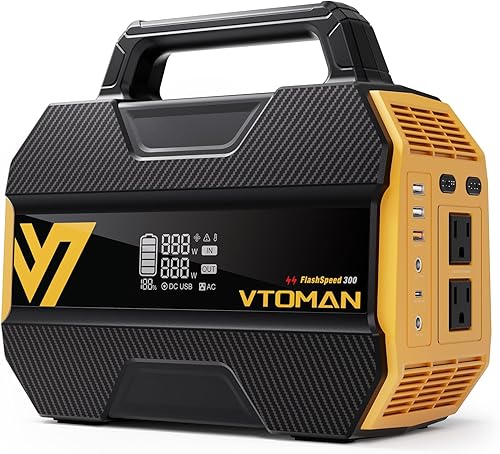
VTOMAN FlashSpeed 300 Portable Power Station
Best for simultaneous charging - 8
 Check it
EnginStar 296Wh Portable Solar Generator
Best for budget weekend trips - 9
 Check it
MARBERO Portable Power Station 88Wh
Best for ultralight backup
Best portable power stations for camping, compared
The top pick wins on balance, not on capacity alone. The larger stations win when your load list includes appliances that draw hundreds of watts for hours.
Jackery Explorer 300 Portable Power Station: Best for lightweight camping
- 292Wh LiFePO4 battery
- 300W rated output, 600W peak
- 2 AC outlets, 100W USB-C PD, 2 USB-A, 120W car port
- 7.5 lb, integrated handle
A light, versatile station for laptops, cameras, drones and small camping gear without adding bulk to your pack.
Pros
- Lightweight integrated handle
- Multiple outlet types for 6 devices
- LiFePO4 battery with 4,000 charge cycles to 70%
Cons
- 300W output limits larger appliances
- Solar panel not included
The Jackery Explorer 300 suits backpackers, hikers and car campers who need power without carrying a heavy box. Its 292Wh capacity and 300W output run laptops, drones, cameras and CPAP devices for useful stretches, while the 7.5 lb weight and integrated handle keep it easy to move between tent and car.
You get 2 AC outlets, a 100W USB-C PD port, 2 USB-A ports and a 120W car port, so six devices can charge at once. That outlet mix matters on a group trip, where phones, headlamps and a camera battery often need power together.
Jackery says the LiFePO4 battery delivers over 4,000 charge cycles before reaching 70% capacity. Solar charging reaches 80% in about 2.8 hours with a 100W panel, which helps on multiday trips with sunny campsites.
The trade-off is clear against the 1,000Wh picks: this station shuts off if you exceed 300W total, so electric pots, kettles and larger fridges are out of scope. Choose it for packability and versatile charging, not for appliance loads.
Jackery Explorer 1000 v2 Portable Power Station: Best for multiday basecamp
- 1070Wh LFP battery
- 1500W AC output, 3000W surge
- 3 AC ports, 2 USB-C, 1 USB-A, 1 DC car port
- 23.8 lb, foldable handle
High capacity and fast charging for fridges, electric pots and several devices at a car basecamp.
Pros
- One hour emergency charging via app
- LFP battery with 4,000 cycles
- LED lights and smart app control
Cons
- Heavier than compact picks
- Solar panel not included
The Jackery Explorer 1000 v2 suits car basecampers who want one station for a fridge, electric pot and several small devices. Its 1070Wh capacity and 1,500W output give far longer runtime than the 300Wh class, and Jackery lists AC units and fridges among the appliances it can power.
At 23.8 lb, it is not a backpacking pick, but the foldable handle and compact shape make it manageable from car to picnic table. Three AC ports, two USB-C ports, one USB-A port and one DC car port support simultaneous charging for a whole camp.
Charging speed is a key strength. Jackery says emergency charging reaches 0% to 100% in one hour when enabled in the app, while the default 1.7 hour mode is meant to protect battery health.
The LFP battery is rated for 4,000 cycles and over 10 years of use.
The trade-off is weight and solar compatibility. It works only with Jackery solar panels for solar charging, and 23.8 lb will feel heavy on a long carry.
For drive-in camping, that trade buys real appliance power.
BLUETTI Portable Power Station AC180: Best for high output power
- 1152Wh LiFePO4 battery
- 1800W output, 2700W peak via app
- 8 outlets
- 500W solar input, 1 hour AC charge
The largest capacity here, with fast charging and UPS function for home backup as well as camping.
Pros
- 1152Wh capacity for longer runtimes
- 1800W output with 8 outlets
- 5-year warranty
Cons
- 37.4 lb is heavy for hiking
- Peak boost needs app activation
The BLUETTI AC180 suits campers who want maximum capacity and output in one unit, plus home backup when the trip ends. Its 1152Wh LiFePO4 battery and 1,800W output are the highest capacity in this group, so runtime stretches longer for fridges, fans and power tools.
Eight outlets help you run several appliances at once. With a tap in the BLUETTI app, output can boost to 2,700W for higher demand loads.
That headroom reduces overload risk when starting some appliances.
Charging is fast in several ways. BLUETTI says AC charging takes one hour at 1,440W input, and solar charging takes 2.8 to 3.3 hours at 500W input.
The station also works as home battery backup with 20 ms switching.
The trade-off is weight at 37.4 lb. This is a car camping or cabin station, not a hiking station.
If you can lift it from trunk to campsite without strain, the capacity and output are hard to beat here.
BLUETTI Elite 100 V2 Portable Power Station: Best for quiet overnight use
- 1024Wh LiFePO4 battery
- 1800W rated output, 2700W Power Lifting
- 80% charge in 45 minutes
- 25 lb, 30dB silent mode
A lighter 1kWh station with quick charging and quiet mode for tent and cabin use.
Pros
- 11 ports for multiple devices
- 10ms UPS backup
- Over 4,000 cycles to 80%
Cons
- Keep upright during storage and transport
- Vehicle fast charging needs BLUETTI Charger 1
The BLUETTI Elite 100 V2 suits campers who want 1kWh class power with less weight than the AC180. Its 1024Wh capacity and 1,800W output run everyday appliances, and BLUETTI says it can power up to 90% of everyday appliances.
At 25 lb with a compact 17L design, it is easier to carry than the AC180, and the hidden handle helps with one-handed transport. Eleven ports let you charge multiple devices at once, which suits families and groups.
Speed and quiet are its main strengths. It reaches 80% in about 45 minutes on AC, and silent mode runs at 30dB, which BLUETTI calls 50% quieter than other 1kWh stations.
That matters for overnight use in a tent or cabin.
The trade-off is care in transport. BLUETTI says not to lay it on its side, since that may damage internal parts.
Keep it upright in the car and at camp, and choose it when quiet, fast charging matters more than the AC180 extra capacity.
ALLWEI Portable Power Station 300W: Best for compact solo trips
- 256Wh LiFePO4 battery
- 300W continuous, 600W peak
- 6 output ports
- 6.4 lb, LED light with SOS
Small and light for solo camping, with dual AC and solar charging in about 2 to 2.5 hours.
Pros
- 6.4 lb backpack friendly
- Pass-through charging
- 5-year warranty
Cons
- 256Wh is small for multiday use
- Solar panel sold separately
The ALLWEI 300W suits solo campers and hikers who want a light station with strong charging options. Its 256Wh capacity and 300W output cover laptops, mini fridges, CPAP machines and drones, and at 6.4 lb it fits in a backpack or car trunk.
Six output ports include 1 AC outlet, 2 DC5521 ports, 1 car port, 1 USB-A fast charge port and 1 USB-C PD 60W port. You can charge up to six devices at once, which is generous for its size.
Recharging flexibility stands out. ALLWEI says wall charging takes 3.5 to 4 hours, car charging takes 3.5 to 4 hours, solar takes 4 to 5 hours with a 100W panel, and dual AC plus solar charging takes 2 to 2.5 hours.
Pass-through charging lets you power devices while the station recharges.
The trade-off is capacity. At 256Wh, it will not match the 1,000Wh picks for multiday appliance use.
Choose it for weight, port variety and charging speed on shorter trips.
Anker SOLIX C300 Portable Power Station: Best for fast USB-C charging
- 288Wh LiFePO4 battery
- 300W output, 600W surge
- 3 AC outlets, 140W two-way USB-C
- 25dB quiet operation
Compact and quiet with strong USB-C charging for laptops, phones, cameras and drones.
Pros
- 80% wall charge in 50 minutes
- 3,000 LiFePO4 cycles
- 5-year warranty
Cons
- Solar panel voltage limited to 11-28V
- Shoulder strap not included
The Anker SOLIX C300 suits campers who charge a lot of modern USB devices. Its 288Wh capacity and 300W output are in the same class as other compact picks, but its 140W two-way USB-C ports are a standout for laptops and drones.
Eight charging ports include 3 AC outlets, 1 car socket, 2 USB-C ports at 140W each, 1 USB-C at 15W and 1 USB-A at 12W. That mix suits a camp where several people need fast charging at the same time.
Anker says wall charging reaches 80% in 50 minutes. The station also charges from solar panels, a car, or a PD 3.1 USB-C port.
At 25dB, it is quiet enough for tent use, and LiFePO4 batteries are rated for 3,000 cycles.
The trade-off is solar limits. Anker specifies 11 to 28V solar panels with an XT60 connector, and panels over 100W can cause a malfunction.
Check panel voltage before you buy, and note that the shoulder strap is sold separately.
VTOMAN FlashSpeed 300 Portable Power Station: Best for simultaneous charging
- 230Wh LiFePO4 battery
- 300W output
- 7 outlets including 100W USB-C
- 7.4 lb, LED light with 3 modes
Seven outputs let a group charge phones, lights, speakers and cameras at once.
Pros
- 80% recharge in about 2 hours via 100W PD
- Pass-through charging
- Over 3,000 LiFePO4 cycles
Cons
- 230Wh is the smallest mid-size capacity here
- Each port has its own limit
The VTOMAN FlashSpeed 300 suits group campers who mostly need to recharge small devices. Its 230Wh capacity and 300W output power phones, speakers, cameras, lights and CPAP machines, and seven outlets let you charge seven devices at once.
The outlet layout is strong for its size: 2 AC outputs, 1 USB-C at 100W, 3 USB-A ports and 1 DC port. A 100W PD input recharges the station to 80% in about 2 hours, and the same port serves as a high speed output for laptops and drones.
Four recharging methods add flexibility: wall socket in about 2.5 hours, solar panel, car outlet for 12V and 24V vehicles, or USB-C PD input. The built-in LED light has steady, strobe and SOS modes for night use at camp.
The trade-off is the smallest capacity in the mid-size group at 230Wh. Runtime will be shorter than the 288Wh to 296Wh picks.
Choose it when simultaneous charging and light features matter more than total stored energy.
EnginStar 296Wh Portable Solar Generator: Best for budget weekend trips
- 296Wh lithium-ion battery
- 300W output, 600W peak
- 2 AC outlets, USB-C 18W, DC outputs
- 6.5 lb, LED light, LCD display
A straightforward 300W station for weekend camping, fans, lamps and phone charging.
Pros
- Pure sine wave AC outlets
- Three charging ways
- Large LCD display
Cons
- Lithium-ion, over 1,000 cycles
- Wall charging takes about 7 hours
The EnginStar 296Wh suits budget weekend campers who want a simple station for basic gear. Its 296Wh capacity and 300W output charge phones, laptops, cameras, CPAP devices and drones, and at 6.5 lb it is easy to carry to a tent.
Two 110V pure sine wave AC outlets, a 12V car port, 2 DC outputs, 2 USB outputs and a USB-C fast charge port give a wide outlet mix. A built-in LED light and large LCD display help you read charge level and manage devices at night.
You can charge it by wall charger in about 7 hours, by solar panel in sunny conditions, or by car charger on the road. EnginStar recommends a full charge every 2 to 3 months to keep the battery in good condition.
The trade-off is battery chemistry and charging time. It uses lithium-ion with over 1,000 charge cycles, while several rivals use LiFePO4 with 3,000 to 4,000 cycles.
Wall charging is also slower here. For occasional weekend trips, that may be an acceptable trade.
MARBERO Portable Power Station 88Wh: Best for ultralight backup
- 88Wh, 24,000mAh battery
- 120W surge, 80W AC output
- 8 output ports
- 3.2 lb, LED light with SOS
The lightest pick, suited to phones, tablets, small TVs and emergency lighting rather than appliances.
Pros
- Slim 6.5 x 4.6 x 3.1 in case
- Charges while charging devices
- BMS safety protection
Cons
- 88Wh capacity is very limited
- 80W AC output suits small devices only
The MARBERO 88Wh suits ultralight campers who need backup for phones and small devices only. Its 88Wh capacity and 80W AC output run small TVs, game consoles, projectors, inflatable beds and drones, and at 3.2 lb it is the lightest pick here.
Eight output ports can be used at once, and the car DC charger output cable can supply car refrigerators, vacuum cleaners and air compressors in emergencies. USB and USB-C PD ports charge phones in about 1 hour, tablets in 1.5 hours and laptops in 2 hours, according to MARBERO.
The adapter charges the station from 0% to 80% in 2 hours, and you can charge other devices at the same time. A three level LED light runs up to 68 hours on the first level, with SOS flashing for emergencies.
The trade-off is capacity. At 88Wh, this is not a multiday appliance station.
Choose it as a slim emergency backup for a tent or car, not as your main power source for a week outdoors.
How to compare portable power stations for camping
We compared capacity, output, weight, battery type, charging methods and outlet layout, because those six factors decide runtime and packability on a trip. A station can have high capacity but low output, or high output but small capacity, and each limit affects different gear.
We checked maker stated specs for every model, including charge times and cycle ratings. Where a maker states a runtime formula, we used that method to explain what to expect rather than promising a fixed time for your devices.
We also weighed portability against power. The 300Wh class weighs about 6 to 7 lb, while the 1,000Wh class weighs 23 to 37 lb.
That gap decides whether you carry power on a trail or from a car trunk.
Buyer patterns in the data point the same way: compact stations suit phones and cameras, while larger stations suit fridges and electric cooking. Our scores reflect that split, so the top pick balances weight and versatility instead of chasing the largest number.
How much capacity do you need for a multiday camping trip?
Most campers need 300Wh for device charging and 1,000Wh or more for appliances. A 300Wh station handles phones, laptops, cameras, lights and fans for a weekend.
A 1,000Wh station adds fridges, electric pots and longer runtimes.
To estimate your need, add up the watt hours you will use each day. Multiply each device wattage by the hours you will run it, then add the totals.
That daily total tells you whether one charge will last a day or whether you need solar recharging.
What 300Wh means in real camp use
A 300W load drains a 300Wh station in about an hour after conversion losses. A 60W load lasts about four to five hours.
Phones and cameras draw far less, so they can charge many times from the same station.
What 1,000Wh means in real camp use
A 1,000Wh station can run a 50W fridge for many hours, and BLUETTI gives an example of about 14.3 hours for its Elite 100 V2. That makes it practical for car camping with food storage, where smaller stations struggle.
Which output wattage do you need for camping gear?
You need output at least as high as your largest device draw. A 300W station suits laptops, drones and small devices.
A 1,500W to 1,800W station suits fridges, electric pots and several appliances at once.
Check both continuous watts and surge watts. Some appliances need a brief surge to start, and the surge rating covers that moment.
The total draw of all devices running at once must also stay under the continuous limit.
Can a 300W station run a fridge?
Some small fridges may run, but many camping fridges draw more than owners expect at startup. The 1,000Wh picks here list fridges among supported appliances, while the 300W picks focus on laptops, drones and cameras.
Check your fridge label before you choose the smaller class.
Do you need pure sine wave output?
Pure sine wave output is safer for sensitive electronics like laptops and CPAP devices. Several picks here state pure sine wave AC output, including the ALLWEI and EnginStar models.
Use that spec as a filter for electronics heavy camps.
How should you recharge a power station while camping?
The best method for most campers is wall charging before you leave, plus solar charging at camp. Wall charging is fastest for a full charge at home.
Solar charging extends trips when you cannot return to an outlet for days.
AC wall charging
Most picks here charge fully in 1 to 4 hours from a wall outlet. The BLUETTI AC180 and Jackery Explorer 1000 v2 both offer about one hour charging, while the EnginStar takes about 7 hours.
Charge fully at home whenever you can.
Solar charging
Solar charging time depends on panel wattage, sun angle and weather. Jackery states 80% in about 2.8 hours with a 100W panel for the Explorer 300.
BLUETTI states 2.8 to 3.3 hours for the AC180 at 500W solar input.
Car charging
Car charging lets you top up while you drive between campsites. Several picks support 12V car charging, including the ALLWEI, VTOMAN and EnginStar models.
It is slower than wall charging, but it works when solar is weak.
Can a portable power station replace a generator at camp?
Yes, for most camping loads, because a power station is quiet, fume free and easy to start. You do not need fuel, and you can use it inside a tent area without exhaust concerns.
The trade-off is stored energy: once the battery is empty, you need to recharge it.
A generator can run for days on fuel, while a power station must be recharged from solar, a car or a wall outlet. For weekend camping with devices and lights, a power station is usually simpler.
For heavy daily appliance use, plan solar charging or choose the largest capacity you can carry.
For RV trips with similar needs, our best portable power station for RV guide covers larger loads and longer stays. If you need power for internet gear, our best portable power station for Starlink Mini guide helps you size that specific load.
How do you size and pack a power station for camping?
Pack by load first, then by weight. List every device, its wattage and hours of use.
Choose a station that covers that total with headroom, then check whether you can carry its weight from car to campsite.
Weight rules for different camping styles
For backpacking, stay under 8 lb and accept 88Wh to 300Wh capacity. For car camping, 23 to 37 lb is manageable if the station stays near the car.
For cabin use, weight matters less than quiet operation and outlet count.
Outlet planning for group camps
Count devices, not just watts. A group may need six to eight ports for phones, lights, cameras and a speaker.
The VTOMAN offers 7 outlets, the BLUETTI AC180 offers 8 outlets, and the MARBERO offers 8 ports in a 3.2 lb case.
Safety and storage tips
Keep stations dry, upright where required, and away from direct heat. BLUETTI says to keep the Elite 100 V2 upright during storage and transport.
EnginStar recommends storing batteries at 40% to 70% charge and recharging every 3 to 6 months.
What battery type and charging features matter most?
LiFePO4 batteries matter most if you camp often, because they offer longer cycle life than standard lithium-ion. The Jackery Explorer 300 and 1,000 v2, both BLUETTI picks, ALLWEI, Anker and VTOMAN all use LiFePO4 or LFP batteries with 3,000 to 4,000 cycle ratings.
Pass-through charging is also useful. It lets you charge devices while the station recharges, which helps at a busy campsite.
ALLWEI, VTOMAN and MARBERO all state pass-through or simultaneous charging.
For laptop heavy trips, fast USB-C charging saves time. Our best portable power station for laptop guide breaks down USB-C wattage needs in more detail.
For vehicle use, our best portable power station jump starter guide covers dual purpose models.
If you prefer one brand for camping, our best Jackery power station for camping guide compares Jackery models head to head. For RV use with Jackery gear, our best Jackery power station for RV guide covers larger loads.
Verdict: which portable power station is best for camping?
Pick the Jackery Explorer 300 if you want packable power for devices, pick the Jackery Explorer 1000 v2 or BLUETTI Elite 100 V2 if you camp from a car with appliances, and pick the MARBERO 88Wh if you only need ultralight backup.
For most readers, the best portable power station for camping is the one you will actually carry and recharge. The Explorer 300 hits that balance at 7.5 lb with 292Wh and 300W output.
The 1,000Wh class wins only when your load list includes a fridge, electric pot or long appliance runtimes.
Before you buy, add up your daily watt hours, check your largest device draw, and confirm solar panel voltage limits. That three step check will point you to the right capacity class faster than any feature list.
Our top 3 picks at a glance
-
1
Best for lightweight camping
Jackery Explorer 300 Portable Power Station
9.7/10 our score
See it on Amazon -
2
Best for multiday basecamp
Jackery Explorer 1000 v2 Portable Power Station
9.6/10 our score
See it on Amazon -
3
Frequently asked questions
How large should a portable power station be for camping?
For phones and cameras, 88Wh to 300Wh is usually enough for a weekend. For a fridge, electric cooking or several days, look at 1,000Wh or more.
Match capacity to your total watt hours per day before you choose weight.
Can a portable power station run a camping fridge?
Yes, if its output and capacity match the fridge draw. The 1,000Wh class picks here list fridges among the appliances they can power.
Check continuous watts and estimate runtime from capacity divided by fridge watts.
How long does a 300Wh station last?
Runtime depends on the load. A 60W device would run about 4.3 hours on a 292Wh station at 85% conversion efficiency, as Jackery explains.
Smaller loads like phones last much longer, while 300W loads drain it in about an hour.
Can I charge a power station with solar panels?
Most picks here support solar charging, but panel voltage and watt limits differ. Jackery Explorer 1000 v2 works only with Jackery solar panels.
BLUETTI and Anker models state voltage ranges, so check those ranges before you buy panels.
Is LiFePO4 better for camping power stations?
LiFePO4 batteries typically give more charge cycles than standard lithium-ion. Several picks here rate 3,000 to 4,000 cycles.
That matters if you camp often, since cycle life affects long term value.


