EcoFlow DELTA 2 Max Review: Worth It? (November 2026)
The EcoFlow DELTA 2 Max is a strong fit for longer home backup and expandable storage because it combines a 2048Wh LiFePO4 battery with 2400W output and up to 6kWh capacity with extra batteries. Choose a smaller RIVER model for lighter loads and easier carrying.
On this page (10 sections)
- EcoFlow DELTA 2 Max review: the short answer
- What does the EcoFlow DELTA 2 Max offer?
- How large is the DELTA 2 Max?
- What can the DELTA 2 Max run?
- Is the DELTA 2 Max good for home backup?
- Can you expand the DELTA 2 Max?
- How should you charge and use it?
- EcoFlow DELTA 2 Max versus the alternatives
- What are the main trade-offs?
- Is the EcoFlow DELTA 2 Max right for you?
The EcoFlow DELTA 2 Max is best for longer backup periods, larger appliances and expandable storage. It suits homes where an outage means more than a dark room for an hour.
Its 2048Wh LiFePO4 battery gives it far more stored energy than a compact station. That matters when a fridge needs to keep cycling through the night.
Its 2400W output covers many household devices at once. You still need to check starting demand for motors and compressors before you plug them in.
Optional expansion to 6kWh is a major reason to consider it. You can start with the main unit and add batteries later if your needs grow.
It is not the lightest choice for occasional phone charging or short trips. At 23 kg, it needs a planned storage spot and a sensible way to move it.
Those lighter needs fit the smaller RIVER 2 Max 500 better. Its 499Wh battery and 13.3 lb weight suit camping and short interruptions.
The DELTA 3 Max is the better match when faster stated recharge and app-based control matter most. It lists 0 to 80 percent charging in 1.13 hours.
For home backup, set up the DELTA 2 Max where you can reach its ports and controls. Keep the charging cable close so you can top it up before a storm.
Plan your priority loads before an outage happens. A fridge, communications gear and medical devices may deserve power before lower use items.
Think about recharging as part of the purchase, not as an afterthought. AC charging is simplest at home, while solar and car charging add options away from the grid.
The trade-off is clear once you weigh capacity against portability. More stored energy means a larger station that rewards fixed placement.
If you want room to grow, that extra capacity becomes the point. If you mainly need light power for quick trips, a smaller model may serve you better.
EcoFlow DELTA 2 Max review: the short answer
The EcoFlow DELTA 2 Max is a strong middle ground between a small camping station and a larger backup system. For another brand’s compact option, see the Anker SOLIX C1000 review.
It has enough capacity for longer appliance use than a 499Wh unit, while its 2400W output covers many household devices.
The key reason to choose it is expandable storage from 2kWh to 6kWh. You can start with the main station and add up to 2 extra batteries if your backup needs grow.
The main trade-off is size and weight. The DELTA 2 Max measures 12.2 x 9.7 x 20 in and weighs 23 kg, so it needs a planned storage spot and a practical way to move it.
For a broader comparison of capacity, output and charging, see our guide to the best portable battery power station.
What does the EcoFlow DELTA 2 Max offer?
The DELTA 2 Max combines a 2048Wh LiFePO4 battery with 2400W output. Its X-Boost mode can reach up to 3400W for high-wattage appliances, although actual use depends on the appliance and its starting demand.
It supports AC wall charging, solar panel charging and car charging. EcoFlow also lists 15 outlets, which gives you more connection space when several devices need power at once.
The battery chemistry is LiFePO4, also called LFP. EcoFlow states that the battery provides 3000 cycles until it reaches 80% capacity, and the unit includes a battery management system that monitors voltage, current and temperature.
Charging speed is another important feature. EcoFlow states that AC charging can reach 80% in 1.1 hours, while combining up to 1000W of solar input with AC can reach 80% in 43 minutes.
How large is the DELTA 2 Max?
The DELTA 2 Max measures 12.2 in long, 9.7 in wide and 20 in high. Its 23 kg weight makes it a substantial portable station rather than something most people will carry with one hand for long periods.
Measure the shelf, closet or vehicle space before buying. Include room for the charging cable, ventilation and the hand positions needed to move the unit safely.
Its size suits a home backup location, RV storage area or campsite setup where the station can remain in one place while powering equipment. It is less convenient for quick day trips than the smaller RIVER 2 Max 500.
Keep the unit where you can reach its ports and controls. A station stored behind other equipment is harder to charge, monitor and disconnect during an outage.
What can the DELTA 2 Max run?
The DELTA 2 Max can run devices within its 2400W output rating, with X-Boost support for some appliances up to 3400W. Refrigerators, microwaves and other equipment may have starting demands that differ from their normal running wattage.
Read the power label on each appliance before connecting it. Add the running wattage of devices you plan to use together, then leave room for startup surges and changing loads.
A 2048Wh capacity gives you a larger energy reserve than the 499Wh RIVER 2 Max 500. That does not create a fixed runtime for every appliance, because a refrigerator cycles on and off while a heater or tool may draw power more steadily.
Use the station for the devices that matter most during an outage. A refrigerator, freezer, medical device or communications setup may deserve priority over lower-use equipment.
For a different EcoFlow model and a smaller power class, compare what the EcoFlow DELTA 2 can run. The useful choice depends on your actual appliance list, not only the headline wattage.
Is the DELTA 2 Max good for home backup?
The DELTA 2 Max is a good home backup choice when you need more stored energy than a compact station and the option to add batteries later. Its quiet operation, no-fume design and multiple charging methods also suit indoor emergency planning.
EcoFlow states that charging noise can start at 30 dB. The station does not use an internal combustion engine, so it does not require fuel, oil changes or engine maintenance.
Do not assume a portable station replaces every home electrical system. Plan which devices you will connect, how you will recharge the battery and where the station will sit during an outage.
The 15 outlets help when several devices must connect, but outlet count does not increase battery capacity. A longer outage still requires load control, solar input, vehicle charging or extra batteries.
If you are comparing brands and sizes, our guide to the best portable power station ecoflow can help you sort the lineup by use.
Can you expand the DELTA 2 Max?
Yes, the DELTA 2 Max can expand from 2kWh to 6kWh with up to 2 extra batteries. This is the strongest reason to choose it over a smaller fixed-capacity station.
Expansion is useful when your normal needs are moderate but outages can last longer. You can begin with the main unit, then add storage after measuring your real energy use.
Extra batteries also require storage space and a plan for charging. Make sure the complete setup fits your room, vehicle or backup area before choosing expansion as your main reason to buy.
Think in terms of loads and hours. If your priority is keeping a refrigerator and communication devices running, calculate their likely energy use before deciding whether 2kWh is enough or 6kWh is necessary.
How should you charge and use it?
Use AC, solar or car charging according to your setup and the manual. AC charging is the simplest option for preparing before an outage, while solar charging can help when grid power is unavailable.
The EcoFlow app can help manage energy use, charging and discharging schedules. Treat app control as a management tool, not a replacement for checking cables, load limits and battery status.
Place the station on a stable, dry surface with access to its ports. Keep cables arranged so they cannot become a trip hazard or pull the station from its position.
For step-by-step operating guidance, read how to use the EcoFlow DELTA 2 Max. For solar planning, compare the best solar panel for the EcoFlow DELTA 2 Max.
EcoFlow DELTA 2 Max versus the alternatives
The DELTA 2 Max is the best fit here when capacity, appliance output and expansion matter most. It offers 2048Wh, 2400W output and expansion to 6kWh.
EF ECOFLOW Portable Power Station DELTA 2 Max 2048Wh, 2400W LiFePO4 Battery: Best for expandable home backup

- 2048Wh capacity
- 2400W output
- Up to 6kWh with 2 extra batteries
- 15 outlets
The DELTA 2 Max is aimed at longer backup periods and larger appliance loads. Its expandable capacity and solar, AC and car charging options make it the closest match for the review topic.
Pros
- Expandable from 2kWh to 6kWh
- 2400W output
- Multiple charging options
- Quiet charging starting at 30 dB
Cons
- Extra batteries are needed for the full 6kWh capacity
- Heavier than the RIVER 2 Max 500
The DELTA 3 Max has the same stated 2048Wh capacity and 2400W output, but its product details list 0–80% charging in 1.13 hours, a 3400W X-Boost output, app control and a 10ms transfer time. Choose it when quicker recharge and transfer performance are higher priorities.
EF ECOFLOW DELTA 3 Max Portable Power: Best for fast recharge

- 2048Wh LFP battery
- 2400W output
- 3400W X-Boost output
- 0–80% charging in 1.13 hours
The DELTA 3 Max suits residential backup and RV use when fast charging, high output and app control matter. Its 2048Wh capacity matches the DELTA 2 Max while its stated 0–80% charge time is shorter.
Pros
- 0–80% charging in 1.13 hours
- 3400W X-Boost output
- 10ms transfer time
- App control
Cons
- Solar panel is optional
- Large format is less portable than the RIVER 2 Max 500
The RIVER 2 Max 500 is the compact alternative. Its 499Wh battery, 1000W output, 13.3 lb weight and 1-hour AC recharge suit camping, short interruptions and lighter devices.
EF ECOFLOW Portable Power Station River: Best for compact backup
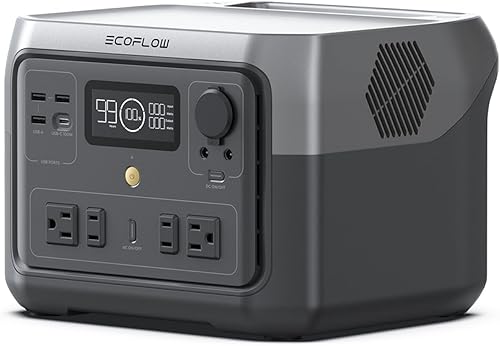
- 499Wh LFP battery
- 1000W output
- 1-hour AC recharge
- 13.3 lb weight
The RIVER 2 Max 500 is easier to carry and fits lighter backup needs. Its 499Wh battery and 1000W output suit essential devices, camping and short power interruptions better than large appliance backup.
Pros
- 13.3 lb weight
- 1-hour AC recharge
- 1000W output
- 220W solar input
Cons
- Much less capacity than the DELTA 2 Max
- Not the best fit for long appliance runtime
A fuel generator is a different type of backup system with different operating needs. If you are considering that route, compare the best dual fuel generator and review what a WEN inverter generator 6800 can run.
For a smaller battery station comparison, see what a 1000 watt BLUETTI power station can run. The deciding factors are stored energy, appliance load, recharge access and how much equipment you want to move.
What are the main trade-offs?
The DELTA 2 Max gives you more capacity than a compact station without forcing you to start at 6kWh. Its expansion path is practical if your backup needs may increase.
Its 23 kg weight is the cost of that capacity. If you need to carry the station often, the RIVER 2 Max 500 is easier to move, but its 499Wh battery cannot provide the same reserve.
The DELTA 3 Max offers faster stated 0–80% charging and a 10ms transfer time. The DELTA 2 Max counters with its clearly stated expansion range, multiple charging methods and 15 outlets.
No single capacity figure guarantees a particular runtime. Your appliance wattage, startup demand, charging access and priority list matter more than the number printed on the front.
Is the EcoFlow DELTA 2 Max right for you?
Choose the EcoFlow DELTA 2 Max if you want 2048Wh of storage, 2400W output and a path to 6kWh for longer home backup or RV use. It suits people who expect outages to last beyond a short inconvenience.
It is especially suitable when several devices must connect at the same time. The 15 outlets give you space for a fridge, chargers and other essentials without constant swapping.
It also fits buyers who want flexibility in how they recharge. AC wall charging, solar charging and car charging cover different setups at home and on the road.
Choose the DELTA 3 Max if its faster stated recharge, app control and 10ms transfer time matter more. That model lists 0 to 80 percent charging in 1.13 hours.
The DELTA 3 Max may suit sensitive electronics that need quick changeover during an outage. Its app can also help you monitor use and set charging schedules.
Choose the RIVER 2 Max 500 if low weight and short-duration backup are more important than long appliance runtime. At 13.3 lb, it is far easier to carry and store.
Its 499Wh battery and 1000W output fit phones, lights, laptops and small camping loads. It is less suited to fridges, microwaves and other larger appliances.
The clearest buying rule is simple: pick the DELTA 2 Max for expandable energy storage. Pick the DELTA 3 Max for faster listed charging features and the RIVER 2 Max 500 for compact everyday portability.
Before you decide, list the appliances you must run first. Add their running wattage and leave room for startup surges from motors.
Then match that list to stored energy, not just peak output. A high output figure helps with starting loads, but capacity decides how long power lasts.
Consider where the station will live between outages. The DELTA 2 Max is 23 kg, so a shelf, closet or RV bay needs real space and safe access.
Plan how you will recharge it during a long outage. Solar input, a vehicle charge or extra batteries can change what the station can sustain.
Care is simple because there is no fuel, oil or engine maintenance. Keep it dry, check cables before use and store it where ventilation is not blocked.
If your needs may grow, expansion makes the DELTA 2 Max easier to justify. If they are modest and fixed, a smaller station may be the cleaner fit.
Frequently asked questions
Is the EcoFlow DELTA 2 Max worth it?
The EcoFlow DELTA 2 Max makes sense when you need 2048Wh of storage, 2400W output and the option to expand to 6kWh with extra batteries. It is less suitable when your main goal is easy carrying or short device charging, where the 499Wh RIVER 2 Max 500 uses less space.
How long will the EcoFlow DELTA 2 Max run appliances?
Runtime depends on the appliance wattage, starting load and how much energy is available. A 2048Wh battery gives more stored energy than the 499Wh RIVER 2 Max 500, but a refrigerator, microwave or tool can use power at different rates.
Check the appliance label and allow for conversion losses.
Can the EcoFlow DELTA 2 Max be expanded?
Yes. The EcoFlow DELTA 2 Max can expand from 2kWh to 6kWh with up to 2 extra solar-powered batteries.
That option helps when you need longer backup, but it adds equipment and cost, so compare your expected load and outage length before choosing the larger system.
How does the DELTA 2 Max compare with the DELTA 3 Max?
The DELTA 3 Max has the same stated 2048Wh capacity and 2400W output as the DELTA 2 Max, but it lists 0–80% charging in 1.13 hours, a 3400W X-Boost mode, app control and a 10ms transfer time. The DELTA 2 Max focuses on expansion to 6kWh and broad charging options.


