9 Best LiFePO4 Power Stations (November 2026)
The best LiFePO4 portable power stations include the Jackery Explorer 300 Portable Power Station for lightweight camping, the Jackery Explorer 1000 v2 Portable Power Station for home backup, and the BLUETTI Portable Power Station AC180 for UPS backup.
On this page (8 sections)
- How we compared these LiFePO4 power stations
- The best LiFePO4 power stations in detail
- How do I choose the best LiFePO4 power station for my needs?
- Which LiFePO4 power station is best for a fridge during an outage?
- Which LiFePO4 portable power station is best for camping and travel?
- Which LiFePO4 power station is best for TVs and home entertainment?
- Should you look at OUPES or VTOMAN LiFePO4 stations too?
- Verdict: which best LiFePO4 power station should you buy?
The best LiFePO4 power station for most buyers is the Jackery Explorer 300 Portable Power Station, because it gives you 292Wh of LiFePO4 capacity and 300W output in a 7.5 lb package. If you need longer home backup, the Jackery Explorer 1000 v2 and the BLUETTI AC180 move you past 1000Wh with 1500W to 1800W output.
Our score weighs specs, features and buyer feedback against what you are shopping for. We compared capacity, output, cycle life, charging speed and port count across all nine models here.
Scores reflect how well each station fits backup power, camping and travel use.
Start with our best portable battery power station guide if you want the broader buying rules. Then use this roundup to narrow the field to LiFePO4 models only.
Our picks at a glance
-
1
 Best for lightweight camping
Jackery Explorer 300 Portable Power Station
9.7/10 our score
See it on Amazon -
2
 Best for home backup
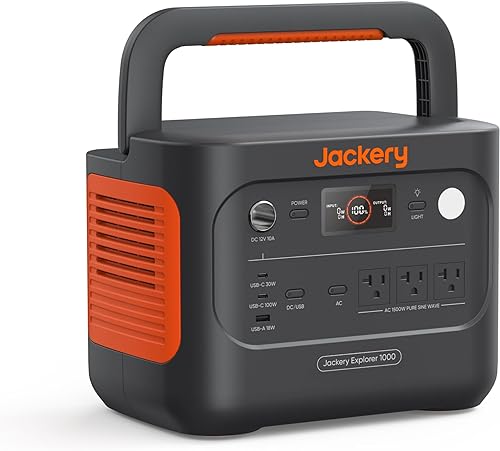
Jackery Explorer 1000 v2 Portable Power Station
9.6/10 our score
See it on Amazon -
3

- 4
 Check it
Anker SOLIX C1000 Gen 2 Portable Power
Best for fast recharging - 5
 Check it
BLUETTI Elite 30 V2 Portable Power Station
Best small unit with high output - 6
 Check it
Anker SOLIX C300 DC Portable Power Station
Best for DC devices - 7
 Check it
DaranEner DARAN Portable Power Station
Best for budget emergencies - 8
 Check it
STARYLINE 1000W Portable Power Station 1024Wh LiFePO4
Best for 1000W value - 9
 Check it
DYNESS Portable Power Station 300W
Best for basic backup
How we compared these LiFePO4 power stations
We checked specs for capacity, output, surge power, cycle life, weight and charging time. We also checked port counts, UPS support and what is included in the box.
LiFePO4 matters because cycle life shapes long term value. Jackery rates two models at over 4,000 cycles to 70 percent capacity.
Anker rates the C1000 Gen 2 at 4,000 cycles to 80 percent capacity. STARYLINE rates its model at 3000 plus cycles to 80 percent capacity.
Capacity and output answer different questions. Capacity in watt hours sets runtime.
Output in watts sets which devices you can run at once. A 288Wh station with 600W output can start a larger device, but it will drain faster than a 1152Wh station.
If you are torn between a station and a standalone inverter, read our portable power station vs inverter guide. That guide explains when a fixed inverter makes more sense than a portable unit.
The best LiFePO4 power stations in detail
The picks below cover light travel models, mid size home backup units and high output stations. Each write up explains who it suits and what trade off to expect.
Jackery Explorer 300 Portable Power Station: Best for lightweight camping
Jackery Explorer 300 Portable Power Station: Best for lightweight camping
- 292Wh LiFePO4 battery
- 300W output and 600W surge
- 7.5 lb weight
- Over 4
- 000 charge cycles
A light LiFePO4 station for camping, travel and small backup needs. It runs devices under 300W and charges in about 3 hours via USB-C.
Pros
- Light at 7.5 lb
- Over 4
- 000 cycles
- 2 AC outlets plus USB-C PD
Cons
- 300W limit excludes high-draw kitchen appliances
- Solar panel not included
This station suits campers and travelers who carry power on hikes or pack it with camping gear. At 7.5 lb, it is the lightest model here, so you will feel the difference on a long carry.
You get 292Wh of LiFePO4 capacity and 300W rated output with 600W surge. That covers laptops, drones, cameras and a CPAP on a camping trip.
It will not cover high draw kitchen appliances, so check device specs first.
Ports include 2 AC outlets, a 100W USB-C PD port, 2 USB-A ports and a 120W car port. You can charge up to 6 devices at once, which helps a group share one unit.
Jackery says the LiFePO4 battery delivers over 4,000 charge cycles before reaching 70 percent capacity. It also says that works out to more than 11 years of service life.
Charging takes about 3 hours via 100W USB-C, about 4 hours from a car port or about 3.5 hours from a Jackery 100W solar panel. With a 100W panel, it reaches 80 percent in about 2.8 hours.
The trade off is capacity. At 292Wh, runtime is short for anything above 100W.
If you want more output in a small body, see the BLUETTI Elite 30 V2 below.
Jackery Explorer 1000 v2 Portable Power Station: Best for home backup
Jackery Explorer 1000 v2 Portable Power Station: Best for home backup
- 1070Wh LFP battery
- 1500W output and 3000W surge
- 23.8 lb weight
- 4000 cycles
A compact 1070Wh station with 1500W output for fridges, AC units and multiple appliances. It charges from 0 to 100 percent in 1 hour with emergency charging through the app.
Pros
- 1500W output
- 1 hour emergency charging
- 3 AC outlets
Cons
- Solar panel not included
- Compatible only with Jackery solar panels
This station suits homeowners who want one unit for outages, camping and road trips. It gives you 1070Wh of capacity and 1500W output in a 23.8 lb body.
That output runs multiple appliances at once, including AC units, fridges and electric pots. Surge peak reaches 3000W, which helps with startup draw on motor driven devices.
Jackery says the LFP battery keeps over 70 percent of its original capacity after 4,000 charge cycles. That is the same long life story as the smaller Jackery, but with far more energy per charge.
Charging is a clear strength. With emergency charging on in the Jackery app, it goes from 0 to 100 percent in 1 hour.
It defaults to 1.7 hours to protect battery health.
Ports include 3 AC outlets, 2 USB-C ports, 1 USB-A port and 1 DC car port, plus LED lights. PD 100W fast USB-C charging helps laptops charge without a separate brick.
The trade off is solar limits. Jackery says this model is compatible only with Jackery solar panels for solar charging.
The solar panel is also not included.
BLUETTI Portable Power Station AC180: Best for UPS backup
BLUETTI Portable Power Station AC180: Best for UPS backup
- 1152Wh LiFePO4 battery
- 1800W output and 2700W peak
- 8 outlets
- 20 ms UPS
A 1152Wh station with 1800W output, 8 outlets and 20 ms UPS backup for essentials. It charges in 1 hour at 1440W AC input and supports expansion batteries.
Pros
- 1800W output
- 20 ms UPS
- Expansion battery support
Cons
- Heavier at 37.4 lb
- Larger footprint for travel
This station suits buyers who need backup power at home plus strong output for travel. It packs 1152Wh of LiFePO4 capacity with 1800W output and 8 outlets.
With a tap in the BLUETTI app, you can boost output to 2700W for higher needs. That peak helps with devices that draw more at startup.
It also works as a home battery backup with UPS switchover in 20 ms. That matters for essentials during a sudden outage, though you should still check which devices must stay on.
Charging takes 1 hour at 1440W AC input. Solar charging at 500W takes about 2.8 to 3.3 hours, and adding AC cuts the time to 1 hour.
BLUETTI says the AC180 supports expansion with B80, B230 and B300 batteries in Power Bank mode. That gives you a path to more capacity later.
The trade off is weight and size. At 37.4 lb, it is the heaviest model here.
It is a home first station that travels, not a hiking pick.
Anker SOLIX C1000 Gen 2 Portable Power: Best for fast recharging
Anker SOLIX C1000 Gen 2 Portable Power: Best for fast recharging
- 1024Wh LiFePO4 battery
- 2000W output and 3000W peak
- 10 ports
- 49 min recharge
A 1024Wh station with 2000W output and 49 minute recharging for outage prep and remote work. It offers 10 ms UPS backup and 10 ports.
Pros
- 2000W output
- 49 min full recharge
- 10 ms UPS
Cons
- Expansion feature removed
- UltraFast charging needs battery above 20 C
This station suits outage prep, camping and remote work setups where fast recharging matters. It delivers 1024Wh capacity with 2000W output and 3000W peak.
That is the highest rated output in this roundup. It powers up to 10 devices at once through 10 ports, which helps if you run laptops, lights and small appliances together.
Anker says HyperFlash tech fully recharges it in 49 minutes at 1600W. You enable that mode in the Anker app.
UltraFast charging activates when battery cell temperature is above 20 C.
Solar recharging takes 1.8 hours with 600W of solar at 60V max. That speed helps off grid and RV use when sun is strong.
Anker says the battery keeps at least 80 percent capacity after 4,000 cycles, under its InfiniPower claim of 10 years. It also provides 10 ms UPS backup for CPAP machines and laptops.
The trade off is expansion. Anker removed the expansion feature to cut weight and size, and points buyers who need expansion to the C1000 instead.
BLUETTI Elite 30 V2 Portable Power Station: Best small unit with high output
BLUETTI Elite 30 V2 Portable Power Station: Best small unit with high output
- 288Wh LFP battery
- 600W output and 1500W surge
- 9.4 lb weight
- 10 ms UPS
A 288Wh station that delivers 600W output, twice the output of many small models. It charges 0 to 80 percent in 45 minutes and runs 9 outlets.
Pros
- 600W output
- 45 min to 80 percent
- 10 ms UPS
Cons
- 288Wh limits runtime
- Solar cable may be needed for some panels
This station suits campers and road trippers who want more power than a typical small unit. It gives you 288Wh capacity with 600W continuous output at 9.4 lb.
Power Lifting Mode raises output to 1500W for short bursts. BLUETTI says that runs camping lights, speakers, car fridges, laptops and CPAP machines, plus a small kettle or toaster.
That 600W base is twice what many small stations offer. It means fewer limits when you plug in a fridge or a power tool for a short job.
Charging is fast too. It reaches 0 to 80 percent in 45 minutes and 0 to 100 percent in 70 minutes, with AC wall charge up to 380W.
It also has 10 ms UPS backup, which protects CPAP machines, laptops and routers during a sudden cut. Standby power is low at 4.5W, according to BLUETTI.
The trade off is runtime. With 288Wh, a 100W load drains the battery in roughly two and a half hours after losses.
Pick capacity for long runs, output for short bursts.
Anker SOLIX C300 DC Portable Power Station: Best for DC devices
Anker SOLIX C300 DC Portable Power Station: Best for DC devices
- 288Wh LiFePO4 battery
- 300W output
- 7 charging ports
- 30 percent smaller design
A compact 288Wh DC-focused station with two 140W USB-C ports and a 120W car socket. It recharges to 80 percent in an hour via dual USB-C.
Pros
- Two 140W USB-C ports
- Compact size
- 7 ports
Cons
- DC focused design
- Shoulder strap sold separately
This station suits travelers who mostly charge phones, tablets and laptops. It gives you 288Wh capacity and 300W output in a compact body that is 30 percent smaller than similar stations.
Ports are DC heavy, with 2 USB-C ports at 140W, 1 USB-C at 100W, 1 USB-C at 15W, 2 USB-A ports and 1 car socket at 120W. That layout favors modern tech over AC appliances.
Fast charging is a strength. It recharges to 80 percent in an hour with dual PD USB-C ports.
You can also use solar or a car.
Anker says it uses a LiFePO4 battery with smart temperature control and an impact resistant design. It also rates it with a 3 year guarantee.
Solar charging works with a 100W panel, and Anker recommends 100W or 60W Anker panels. It is not compatible with PS30, PS200 or PS400 panels.
The trade off is AC power. This is a DC first station, so do not pick it if your main need is a fridge or other AC load.
For AC backup, see the larger Anker C1000 Gen 2.
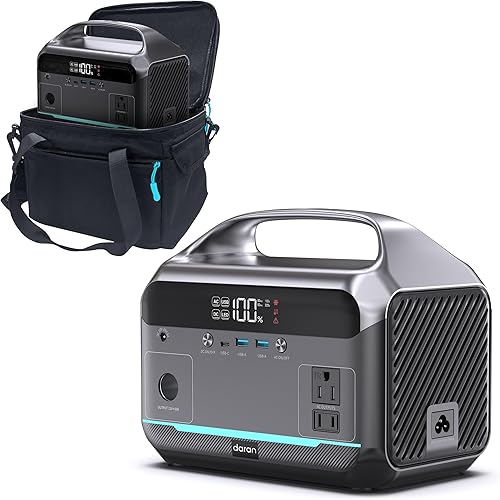
DaranEner DARAN Portable Power Station: Best for budget emergencies
DaranEner DARAN Portable Power Station: Best for budget emergencies
- 288Wh LiFePO4 battery
- 350W output and 600W surge
- 8.2 lb weight
- 2.1 hour fast charging
A 288Wh station with 350W output for CPAP, mini fridges and small appliances. It weighs 8.2 lb and includes a storage bag and AC charging cable.
Pros
- Light at 8.2 lb
- 350W output
- Storage bag included
Cons
- Designed for devices at 350W or less
- Solar panels and car cables sold separately
This station suits buyers who want a light emergency unit without paying for the largest capacity. It gives you 288Wh LiFePO4 capacity with 350W output and 600W surge.
At 8.2 lb, it is easy to stow in camping gear or a home emergency kit. Its size is 10.0 x 6.6 x 8.2 inches, which fits in a car trunk or closet shelf.
DaranEner says the 0.85 conversion rate supports a 30W CPAP for up to 8.16 hours or a 100W stew pot for about 2.44 hours. Use those as estimates, not promises, since real loads vary.
Ports include 2 AC outlets, 1 60W PD USB-C port, 2 USB-A ports and 1 DC I/O port. You can charge several devices at once for a family trip.
It charges via wall, car 12V or solar, though solar panels and car charging cables are sold separately. The box includes the station, a storage bag, an AC charging cable and a user manual.
The trade off is the 350W limit. It is designed for devices at 350W or less, so check every appliance against that cap before you buy.
STARYLINE 1000W Portable Power Station 1024Wh LiFePO4: Best for 1000W value
STARYLINE 1000W Portable Power Station 1024Wh LiFePO4: Best for 1000W value
- 1024Wh LiFePO4 battery
- 1000W output and 2000W peak
- 3000 plus cycles
- 300W solar input
A 1024Wh station with 1000W output for lights, routers and mini fridges. It retains 80 percent capacity after 3000 plus cycles, according to STARYLINE.
Pros
- 1024Wh capacity
- 1000W output
- 300W solar input
Cons
- Shorter cycle claim than 4000 cycle rivals
- Fewer buyer reports in data
This station suits buyers who want 1024Wh capacity and 1000W output at a lower tier. It gives you 1024Wh LiFePO4 capacity with 1000W continuous output and 2000W peak.
STARYLINE says it powers lights, routers and mini fridges for 2 to 3 days during outages. Treat that as a best case estimate, since fridge cycling and other loads change the math.
Ports include 2 AC outlets, 1 60W PD USB-C port and 2 USB-A ports, so you can power 5 devices at once. The 60W USB-C port charges a laptop to 50 percent in about 30 minutes, according to STARYLINE.
Safety is a focus here. It has a 6 layer smart BMS against overcharge, overload, short circuit and high temperature.
STARYLINE says 3000 plus cycles retain 80 percent capacity and last 6 years.
Solar input goes up to 300W, and an optional 200W panel fully charges it in 6 to 8 hours on sunny days. Wall charging takes about 4.5 hours.
The trade off is cycle life and track record. At 3000 plus cycles, it trails the 4000 cycle claims from Jackery and Anker, so long term value depends on price.
DYNESS Portable Power Station 300W: Best for basic backup
DYNESS Portable Power Station 300W: Best for basic backup
- 256Wh LiFePO4 battery
- 300W output and 600W starting power
- 6 output ports
- Digital display
A 256Wh station with 300W output for laptops, routers, mini fridges and cameras. It charges in about 3.5 to 4 hours via AC, solar or car.
Pros
- 6 output ports
- Digital display
- Multiple charging options
Cons
- 256Wh is smallest capacity here
- 300W total limit
This station suits basic home backup and camping needs on a smaller budget. It gives you 256Wh LiFePO4 capacity with 300W output and 600W starting power.
That covers laptops, routers, mini fridges and cameras, according to Dyness. Total wattage of all connected devices must stay under 300W.
Ports include 1 AC outlet, 1 USB-C port, 1 USB-A port, 2 DC outputs and 1 car outlet. You can power multiple small devices at once for RV or van life.
Charging takes about 3.5 to 4 hours via AC wall outlet, a 100W solar panel or a car outlet. Using AC plus solar together cuts the time to about 2 hours.
Dyness gives a runtime formula: 256Wh times 87 percent divided by your device watts. A 50W device gives about 4.5 hours by that estimate.
The trade off is capacity. At 256Wh, it is the smallest battery here.
If you need overnight fridge backup, step up to a 1000Wh class model.
How do I choose the best LiFePO4 power station for my needs?
Start with output, then check capacity. Output decides what you can run.
Capacity decides how long you can run it.
How much output do you need?
Small stations here run 300W to 350W. That fits laptops, phones, cameras, routers and CPAP machines.
It does not fit high draw kitchen appliances.
Mid size stations run 1000W to 2000W. That fits fridges, lights, TVs, power tools and several devices at once.
The Anker C1000 Gen 2 leads at 2000W.
Surge or peak power helps with startup draw. Motors in fridges and pumps draw more at start.
Check both rated output and surge before you buy.
How much capacity do you need?
Estimate runtime with this formula: capacity times 0.85 divided by device watts. A 100W load on a 288Wh station gives about 2.4 hours.
For overnight fridge backup, look at 1000Wh class models. The Jackery 1000 v2, BLUETTI AC180, Anker C1000 Gen 2 and STARYLINE all sit near 1024Wh to 1152Wh.
For phone and laptop charging on a trip, 256Wh to 292Wh is often enough. The Jackery Explorer 300 and DYNESS cover that role.
How important is cycle life to you?
LiFePO4 chemistry is the reason cycle life is a headline here. Jackery rates 4,000 cycles to 70 percent.
Anker rates 4,000 cycles to 80 percent.
If you will cycle the station daily for RV life, that difference matters. If you will store it for rare outages, charging speed and UPS support may matter more.
How fast do you need to recharge?
Fast charging helps after an outage or on a short trip. The Anker C1000 Gen 2 recharges in 49 minutes.
The Jackery 1000 v2 charges in 1 hour with emergency mode on.
The BLUETTI AC180 also charges in 1 hour at 1440W AC input. The BLUETTI Elite 30 V2 reaches 80 percent in 45 minutes.
Solar speed depends on panel size and sun. A 500W solar input charges the AC180 in about 2.8 to 3.3 hours.
A 600W input charges the Anker C1000 Gen 2 in 1.8 hours.
What ports and features do you need?
Count the devices you travel with. The BLUETTI AC180 gives 8 outlets.
The Anker C1000 Gen 2 gives 10 ports. The Jackery Explorer 1000 v2 gives 3 AC outlets.
UPS support matters for home backup. The AC180 switches in 20 ms.
The Anker C1000 Gen 2 and BLUETTI Elite 30 V2 switch in 10 ms.
App control helps you manage charging modes. Jackery offers 1 hour emergency charging, 30 dB quiet overnight charging and energy efficiency mode through its app.
Which LiFePO4 power station is best for a fridge during an outage?
Pick 1000Wh class capacity with at least 1000W output for fridge backup. That gives you headroom for startup draw and longer runtime.
The Jackery Explorer 1000 v2 is a strong pick at 1070Wh and 1500W. The BLUETTI AC180 adds 1152Wh and 1800W.
The Anker C1000 Gen 2 adds 1024Wh and 2000W.
Small 288Wh stations can run a mini fridge for a short time, but they drain fast. Use our best portable power station for refrigerator guide to match fridge draws to station size.
Always check your fridge specs before you buy. Startup draw can exceed running draw, and total connected wattage must stay under the station limit.
Which LiFePO4 portable power station is best for camping and travel?
Pick weight and port mix first for camping. A station you will carry daily is useless if it is too heavy for your pack.
The Jackery Explorer 300 at 7.5 lb is the lightest pick here. The DaranEner at 8.2 lb and BLUETTI Elite 30 V2 at 9.4 lb are also easy to carry.
For tent camping with phones and lights, 256Wh to 292Wh is enough. For car camping with a fridge and projector, step up to 1000Wh class.
Our best portable power station for camping guide breaks down tent, RV and van setups. Our best expandable portable power stations guide covers models that grow with extra batteries.
Which LiFePO4 power station is best for TVs and home entertainment?
Pick enough AC outlets and 1000W plus output for TV use. A single outlet gets crowded fast in a living room outage.
The BLUETTI AC180 gives 8 outlets, which helps with a TV, router and lights. The Jackery Explorer 1000 v2 gives 3 AC outlets plus USB ports for phones and remotes.
Small stations can run a TV, but runtime drops with each added device. See our best portable power station for tv guide for TV specific sizing.
Should you look at OUPES or VTOMAN LiFePO4 stations too?
Yes, if you want more brand options in the same class. Brand specific roundups help you compare fans, ports and charging speeds.
Our best oupes portable power station guide covers OUPES models side by side. Our best vtoman portable power station guide does the same for VTOMAN.
Use those guides to check cycle life, solar input and included cables before you decide. They sit in the same backup power cluster as this roundup.
Verdict: which best LiFePO4 power station should you buy?
Buy the Jackery Explorer 300 for light camping and small backup needs. It gives you 292Wh, 300W output and 4,000 cycle life at 7.5 lb.
Buy the Jackery Explorer 1000 v2 for home backup. It gives you 1070Wh, 1500W output and 1 hour emergency charging.
Buy the BLUETTI AC180 if UPS backup is your top priority. It gives you 1152Wh, 1800W output and 20 ms switchover with expansion support.
Buy the Anker SOLIX C1000 Gen 2 for fast recharging and high output. It gives you 1024Wh, 2000W output and a 49 minute recharge.
Buy the BLUETTI Elite 30 V2 if you want a small station with 600W output. It is the best small body pick for higher draws.
Pick by output first, capacity second and cycle life third. That order keeps you from buying a station that cannot start your fridge or that dies too fast on a camping trip.
Our top 3 picks at a glance
-
1
Best for lightweight camping
Jackery Explorer 300 Portable Power Station
9.7/10 our score
See it on Amazon -
2
Best for home backup
Jackery Explorer 1000 v2 Portable Power Station
9.6/10 our score
See it on Amazon -
3
Frequently asked questions
How long does a LiFePO4 power station last?
Jackery says its Explorer models keep over 70 percent capacity after 4,000 charge cycles, which it rates as more than 10 years of service. Anker says the SOLIX C1000 Gen 2 keeps at least 80 percent after 4,000 cycles.
STARYLINE says its 1024Wh model keeps 80 percent after 3000 plus cycles.
Real life depends on how often you cycle it and how you store it.
Can a portable power station run a fridge?
Yes, if the fridge draw stays within the station output and the total wattage of all devices stays under that limit. The Jackery Explorer 1000 v2 provides 1500W output for fridges and other appliances.
The BLUETTI AC180 provides 1800W output.
Check your fridge specs first, since startup draw can exceed running draw.
How do I estimate runtime?
Use capacity times 0.85 divided by device watts as a rough guide. Jackery gives that formula for the Explorer 300.
For example, a 60W device on a 292Wh station gives about 4.3 hours.
Actual runtime varies with load, temperature and how much other gear is plugged in.
Do LiFePO4 stations need a solar panel?
No. Most models here charge from a wall outlet, a car port or solar.
Jackery and BLUETTI models list AC charging as a primary option.
Solar panels are optional for off grid use, and some brands limit solar charging to their own panels.


