9 Best Portable Power Stations for Refrigerators (November 2026)
The best portable power stations for refrigerators include the Jackery Explorer 300 Portable Power Station for mini fridges and light backup, the Jackery Explorer 1000 v2 Portable Power Station for most home refrigerators, and the EF ECOFLOW Portable Power Station Delta 3 Classic for fast switchover backup.
On this page (11 sections)
- How we picked these portable power stations for refrigerators
- The best portable power stations for refrigerators in detail
- How much power does a refrigerator compressor need to start?
- How long will a portable power station run a refrigerator?
- Portable power station for refrigerator use: UPS or not?
- How many cubic feet is a chest freezer? Tips that work for fridge backup too
- Should you compare a portable power station vs generator for a fridge?
- What if you need power for a TV or other room loads too?
- How do you size a portable power station to power a refrigerator?
- How do you set up and care for a fridge backup station?
- Which portable power station that can run a refrigerator should you buy?
The best portable power station for refrigerator backup for most homes is a 1,000Wh class unit with at least 1,500W rated output, because a fridge compressor needs surge power at startup and steady power while it cycles. A small 300W station can run a mini fridge, but a full size refrigerator will drain it fast.
Our score weighs specs, features and buyer feedback against what you are shopping for. We compared capacity, rated output, peak surge, charging speed, UPS switchover and battery life across these picks.
Our picks at a glance
-
1
 Best for mini fridges and light backup
Jackery Explorer 300 Portable Power Station
9.7/10 our score
See it on Amazon -
2
 Best for most home refrigerators
Jackery Explorer 1000 v2 Portable Power Station
9.6/10 our score
See it on Amazon -
3
 Best for fast switchover backup
EF ECOFLOW Portable Power Station Delta 3 Classic
9.5/10 our score
See it on Amazon
- 4
 Check it
BLUETTI Portable Power Station AC180
Best for expandable fridge backup - 5
 Check it
Anker SOLIX C1000 Gen 2 Portable Power
Best for high output and fast recharge - 6
 Check it
BLUETTI Elite 100 V2 Portable Power Station
Best for quiet indoor use - 7
 Check it
Anker SOLIX C300 DC Portable Power Station
Best for DC powered coolers and devices - 8
 Check it
ALLWEI Portable Power Station 300W
Best budget mini fridge backup - 9
 Check it
OUPES Mega 1 Portable Power Station 1024Wh
Best for expandable long outages
How we picked these portable power stations for refrigerators
We checked rated output first, because a fridge that will not start is useless no matter how large the battery is. We then checked capacity, because runtime decides whether you can keep food cold through a real outage.
We looked at peak surge next, since many compressors draw two to three times their running watts for a short burst. We also weighed charging speed, LiFePO4 battery life, weight and UPS switchover time.
If you want the broader buying context, start with our best portable battery power station guide. It explains capacity, output and battery chemistry in plain terms.
The best portable power stations for refrigerators in detail
The picks below move from the highest score down. Each one suits a different fridge size, outage length or carry limit.
Read the trade offs before you compare prices.
Jackery Explorer 300 Portable Power Station: Best for mini fridges and light backup
- 292Wh capacity
- 300W rated output with 600W peak surge
- 2 AC outlets
- LiFePO4 battery with over 4,000 charge cycles
- 7.5 lb class weight
A light unit for a mini fridge, cooler or short outage bridge, not a full size refrigerator for a long night.
Pros
- Very light and easy to carry
- 600W peak surge helps compressor startup
- Long life LiFePO4 chemistry
Cons
- 292Wh is small for a full size fridge
- Only 300W rated output
The Jackery Explorer 300 suits a mini fridge, beverage cooler or a short bridge during a brief outage. Its 292Wh capacity and 300W rated output keep the weight low at about 7.5 lb.
Its 600W peak surge helps a small compressor start without tripping the output limit. That surge matters more than the headline 300W figure for fridge use.
The LiFePO4 battery is rated for over 4,000 charge cycles, so it should hold up for years of occasional backup use. It also charges in about 3 hours via USB-C or about 4 hours from a car port.
You get 2 AC outlets, a 100W USB-C PD port, 2 USB-A ports and a 120W car port. That mix is handy for phones and lights while the fridge runs.
The trade off is clear. A standard refrigerator averaging 60W would run for only about 4 hours by the maker's formula, and a larger fridge would run for less.
Choose this for small cooling loads, not overnight protection for a full size fridge.
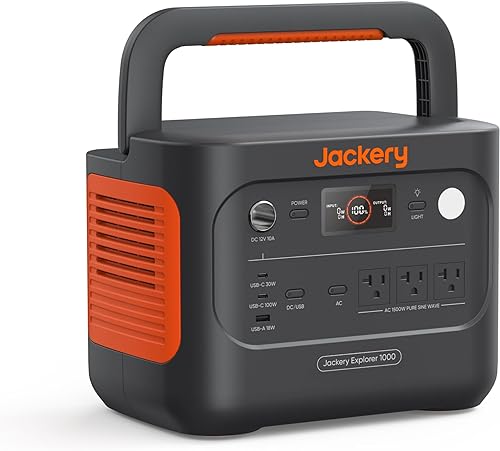
Jackery Explorer 1000 v2 Portable Power Station: Best for most home refrigerators
- 1,070Wh capacity
- 1,500W AC output with 3,000W surge peak
- 3 AC ports
- LFP battery with 4,000 charge cycles
- 1 hour emergency charging via app
The balanced pick for a standard refrigerator, with enough capacity for several hours and enough surge for startup.
Pros
- 1,500W output covers most fridge startup
- 1,070Wh gives useful runtime
- Fast charging options
Cons
- 23.8 lb is not a one hand carry for everyone
- Solar charging is limited to Jackery panels
The Jackery Explorer 1000 v2 is the balanced pick for a standard home refrigerator. Its 1,070Wh capacity and 1,500W AC output give you both runtime and startup headroom.
The 3,000W surge peak covers many compressor starts that would trip a 300W unit. Jackery lists fridges among the appliances this model can power.
At 23.8 lb, it is heavy enough that you will want a set spot near the fridge rather than moving it daily. The foldable handle helps for occasional moves.
Charging is a strength. The emergency mode in the Jackery app charges from 0 to 100 percent in 1 hour, while the default 1.7 hour mode is meant to protect battery health.
You get 3 AC ports, 2 USB-C ports, 1 USB-A port and 1 DC car port, plus LED lights. That lets you run the fridge plus a phone, router or work light at the same time.
The main limit is solar. Jackery says this model is compatible only with Jackery solar panels for solar charging, so plan for wall or car charging if you use other brands.
EF ECOFLOW Portable Power Station Delta 3 Classic: Best for fast switchover backup
- 1,024Wh capacity
- 1,800W output with 3,600W surge
- Under 10ms UPS switchover
- LiFePO4 battery
- 0 to 80 percent in 45 minutes with X-Stream
Strong output and fast switchover make it a good fridge backup when you care about brief interruptions.
Pros
- 1,800W output with high surge
- Under 10ms UPS
- Fast AC charging to 80 percent
Cons
- 26.7 lb weight
- Not compatible with DELTA 2 or DELTA 3 extra batteries
The EF ECOFLOW Delta 3 Classic suits buyers who want fast switchover and strong output for a fridge. Its 1,800W output and 3,600W surge handle startup draws with ease.
The headline feature is the under 10ms UPS switchover. That can keep a fridge control board from resetting during a brief cut, even though the battery still decides total runtime.
With 1,024Wh, expect several hours for a typical fridge, depending on average draw. The X-Stream charger reaches 0 to 80 percent in 45 minutes, which helps if outages repeat.
At 26.7 lb, it is a station you place once and leave in place. The EcoFlow app lets you monitor use and set backup modes.
The trade off is expansion. This model is not compatible with DELTA 2 or DELTA 3 series extra batteries, so capacity is fixed at 1,024Wh.
If you may need more runtime later, look at an expandable pick instead.
BLUETTI Portable Power Station AC180: Best for expandable fridge backup
- 1,152Wh LiFePO4 capacity
- 1,800W output with 2,700W peak via app boost
- 8 outlets
- 20ms UPS
- Expansion with B80, B230 or B300 batteries
More capacity than most 1kWh picks and expansion options if you want longer fridge runtime later.
Pros
- 1,152Wh capacity
- Expansion battery support
- 1 hour AC charging
Cons
- 37.4 lb is the heaviest pick here
- Boost to 2,700W needs app activation
The BLUETTI AC180 suits a fridge owner who wants more than 1,024Wh without jumping to a much larger station. Its 1,152Wh LiFePO4 capacity is the largest base capacity in this group.
It delivers 1,800W output and 8 outlets, with an app boost to 2,700W for higher needs. That boost gives extra surge headroom for a stubborn compressor.
The 20ms UPS helps with brief interruptions, though it is slower than the 10ms picks. For a fridge, that difference is usually minor compared with total runtime.
Expansion is the big draw. It supports B80, B230 and B300 expansion batteries in Power Bank mode, so you can add capacity later for a longer outage.
The cost is weight. At 37.4 lb, it is the heaviest pick here and not a unit you will carry to a campsite often.
It is best as a fixed home backup station.
Anker SOLIX C1000 Gen 2 Portable Power: Best for high output and fast recharge
- 1,024Wh capacity
- 2,000W output with 3,000W peak
- 10 ports
- 10ms UPS
- 49 minute recharge with HyperFlash
High output for a fridge plus other essentials, with fast recharge for repeat outages.
Pros
- 2,000W output
- Fast 49 minute recharge
- 10ms UPS
Cons
- No expansion battery support
- 11.3 kg weight to carry room to room
The Anker SOLIX C1000 Gen 2 suits a fridge plus other essentials during an outage. Its 2,000W output and 1,024Wh capacity leave room for a router, lights or a laptop while the compressor runs.
The 3,000W peak surge handles startup, and the 10ms UPS keeps vital gear running through a switchover. That combination is useful if the fridge is in the same circuit as sensitive electronics.
HyperFlash recharging reaches full charge in 49 minutes when enabled in the app. That speed matters if the power comes back for a short window between outages.
The unit has 10 ports, so you can power up to 10 devices at once. At 11.3 kg, it is still a two hand carry for most people.
The trade off is expansion. Anker removed expansion on this model to cut weight and size.
If you need more than 1,024Wh, you will need a different model rather than adding a battery.
BLUETTI Elite 100 V2 Portable Power Station: Best for quiet indoor use
- 1,024Wh capacity
- 1,800W rated output with 2,700W Power Lifting
- 10ms UPS
- 30dB silent mode
- 80 percent in 45 minutes
A quiet 1kWh option for a fridge in a living space where fan noise matters at night.
Pros
- 30dB silent mode
- Compact 25 lb design
- 10ms UPS
Cons
- Must stay upright in storage and transport
- Third party solar panels have voltage limits
The BLUETTI Elite 100 V2 suits a fridge in a living area where noise matters. Its 30dB silent mode is much quieter than a typical 1kWh station during overnight use.
It has 1,024Wh capacity, 1,800W rated output and 2,700W Power Lifting for startup surges. The 10ms UPS helps keep Wi-Fi and other gear alive during a cut.
TurboBoost charging reaches 80 percent in about 45 minutes from AC. That is fast enough to top up between outages without planning a full day.
At 25 lb with a compact 17L design, it is easier to move than the AC180. The hidden handle helps for a one hand carry over short distances.
One limit matters for storage. BLUETTI says do not lay it on its side, as that may damage internal parts.
Keep it upright during storage and transport, and plan your shelf space that way.
Anker SOLIX C300 DC Portable Power Station: Best for DC powered coolers and devices
- 288Wh capacity
- 300W output
- 7 device charging ports
- LiFePO4 battery
- 30 percent smaller design
Best when your cooler or fridge runs on DC or USB-C, not for a standard AC refrigerator.
Pros
- Very portable size
- Two 140W USB-C ports
- Good for DC coolers
Cons
- No AC outlet for a standard refrigerator
- 288Wh limits runtime
The Anker SOLIX C300 DC suits DC powered coolers, not a standard AC refrigerator. It has 288Wh capacity and 300W output through USB-C and car ports, with no AC outlet.
That makes it a poor choice if your fridge plugs into a wall outlet. It is a good choice if you run a car cooler or a portable fridge that accepts DC power.
The 7 charging ports include two 140W USB-C ports, a 100W USB-C port, a 15W USB-C port, 2 USB-A ports and a 120W car socket. That mix suits laptops, phones and cooler power together.
At 2.8 kg and 30 percent smaller than similar stations, it is easy to carry to a campsite or keep in a car. It recharges to 80 percent in an hour via dual PD USB-C.
The LiFePO4 battery and 3 year guarantee help for long term use. The trade off is runtime.
Even a modest cooler will drain 288Wh in a few hours, so treat it as a portable top up, not overnight fridge protection.
ALLWEI Portable Power Station 300W: Best budget mini fridge backup
- 256Wh capacity
- 300W continuous power with 600W peak surge
- Pure sine wave AC outlet
- LiFePO4 with 3,000 cycles
- 6.4 lb weight
A low cost, light option for a mini fridge or a fridge compressor that draws modest power.
Pros
- Light at 6.4 lb
- 600W peak surge
- Pass through charging
Cons
- 256Wh is the smallest capacity here
- Single AC outlet
The ALLWEI 300W suits a mini fridge or a small fridge with a low compressor draw. Its 256Wh capacity and 300W continuous output are modest, but the 600W peak surge helps at startup.
Pure sine wave output is a plus for motor loads and sensitive electronics. That is the safer output type for a compressor compared with a modified sine wave unit.
At 6.4 lb, it is the lightest AC pick here and easy to store in a closet or car. It also has a 3 level LED light with SOS mode for outages.
The LiFePO4 battery is rated for 3,000 cycles, and the BMS adds 6 layers of protection. Pass through charging lets you charge the station and your devices at the same time.
The limit is capacity. A full size fridge averaging 50W to 80W would get only about 3 to 4 hours of runtime.
Choose this for small fridges, or as a backup for a second mini fridge in a garage or office.
OUPES Mega 1 Portable Power Station 1024Wh: Best for expandable long outages
- 1,024Wh capacity
- 2,000W continuous output with 4,500W surge
- Under 20ms UPS
- Expansion to 5,120Wh with two B2 batteries
- 0 to 80 percent in 36 minutes via AC
High surge and large expansion potential suit a fridge plus other loads during a longer outage.
Pros
- 4,500W surge
- Expand to 5,120Wh
- Very fast AC charging
Cons
- 27.8 lb weight
- Expansion needs separate B2 batteries
The OUPES Mega 1 suits a fridge owner who may need more runtime later. Its 2,000W output and 4,500W surge are the highest surge figure in this group.
That surge headroom helps with large compressors or a fridge that also runs a defrost heater. Pure sine wave output protects sensitive electronics on the same station.
Capacity starts at 1,024Wh, which is enough for several hours for most fridges. You can add up to two B2 extra batteries to reach 5,120Wh without extra inverters.
Charging is very fast. It reaches 0 to 80 percent in 36 minutes via AC, or 26 minutes when AC and solar inputs combine.
The smart BMS balances cells and guards against overcharge.
At 27.8 lb, it is a fixed home unit, not a hiking unit. The under 20ms UPS is slower than 10ms picks, but total capacity and surge are stronger here.
How much power does a refrigerator compressor need to start?
A refrigerator needs surge power at startup, not just running watts. Most full size models draw 800W to 1,500W for a few seconds when the compressor kicks on.
That is why a 300W station often trips on a full size fridge even if the fridge averages only 50W to 100W while running. The rated output must clear the running load, and the peak surge must clear the start.
The 1,500W to 2,000W picks here give you that margin. The 300W picks suit mini fridges, beverage coolers and small DC coolers.
Check the nameplate on your fridge for running watts and starting watts. If starting watts are missing, assume you need at least 1,000W of surge headroom.
Our can a chest freezer run on a 20 amp circuit guide explains how circuit limits differ from portable station limits. A station runs off its own battery, so your home wiring does not limit its output.
How long will a portable power station run a refrigerator?
Runtime comes from capacity divided by average draw. Use this rough formula: capacity in Wh times 0.85, divided by average watts.
A 1,024Wh station at a 50W average load gives about 17 hours on paper. A 292Wh station at 60W gives about 4 hours.
Real runtime is often lower.
Door openings, warm room air and a dirty condenser coil all raise average draw. A fridge in a hot garage will cycle more often than one in a cool kitchen.
If you need overnight protection, aim for at least 1,000Wh for a full size fridge. For a mini fridge, 256Wh to 292Wh can cover a few hours or a short outage.
Portable power station for refrigerator use: UPS or not?
UPS switchover time matters for electronics, less for a fridge compressor. A fridge can tolerate a brief cut, but its control board may reset.
Models with under 10ms UPS switch almost instantly. Models at 20ms are still fast enough for most fridge use, but slower for sensitive gear.
If you also run a router, PC or medical device on the same station, faster switchover is worth paying for. If the fridge is the only load, capacity matters more.
Our portable power station vs UPS guide breaks down when each tool fits. For a multi hour outage, a power station wins because a UPS battery is usually too small.
How many cubic feet is a chest freezer? Tips that work for fridge backup too
Fridge size drives power needs. A larger cabinet has a larger compressor and more door openings, so it draws more power on average.
If you are also backing up a chest freezer, size matters there too. Our guide to how many cubic feet is a chest freezer helps you match storage to load.
A portable power station that can run a refrigerator may not run a fridge plus a freezer at the same time. Two compressors starting together can exceed surge limits.
Run one cooling appliance per station if you want reliable starts. If you must run both, choose a 2,000W station and stagger the starts.
Should you compare a portable power station vs generator for a fridge?
A portable power station is quieter and easier to use indoors. A generator can run for days on fuel, but it must stay outside and needs refueling.
For a fridge during a 4 to 8 hour outage, a 1,000Wh station is simpler. For a 2 day outage, a generator gives more total energy.
Our portable power station vs generator guide compares noise, runtime, fuel and indoor safety. That choice often comes down to outage length, not peak power.
Many households use both. The station bridges the first hours, and the generator recharges it later.
What if you need power for a TV or other room loads too?
A fridge rarely runs alone during an outage. You may also want a router, phone chargers and a light.
A 1,500W station can handle a fridge plus small loads if total running watts stay below its rating. Add up your loads before you plug them in.
Our best portable power station for TV guide helps you size a station for a TV plus a fridge. A TV adds 80W to 150W, which cuts fridge runtime noticeably.
If you plan to run several rooms, look at our best portable power station for home backup guide for larger stations.
If you prefer BLUETTI models, see our best BLUETTI power station for refrigerator guide for a focused comparison.
How do you size a portable power station to power a refrigerator?
Check your fridge nameplate first
Look for running watts, starting watts and voltage on the label inside the fridge door or on the back. Write those numbers down before you shop.
If only amps are listed, multiply amps by volts to get watts. A 1.5 amp fridge on 120 volts draws about 180 watts at startup in that estimate.
Add a safety margin for startup surge
Choose a station whose peak surge is at least double your fridge running watts. For most full size fridges, that means 1,500W rated output or more.
A 300W station with 600W surge can start a mini fridge, but it will not start most full size compressors. Surge margin is not extra, it is required.
Match capacity to outage length
For a 4 hour outage, 1,000Wh is a safe starting point for a full size fridge. For overnight use, consider expansion batteries or a larger station.
A portable power station to run a refrigerator for a full day usually needs 2,000Wh or more. That is where expandable models earn their keep.
Keep other loads small
A router, phone and LED light add little load. A microwave, kettle or space heater will cut runtime fast and may trip the output.
Plug the fridge in first, then add small loads one at a time. Watch the station display for total watts.
How do you set up and care for a fridge backup station?
Place it near the fridge, upright and ventilated
Keep the station on a flat surface with air space around its vents. Do not lay units on their side if the manual says to keep them upright.
Store it where room temperature stays moderate. Extreme heat or cold can affect battery life and charging speed.
Test it before an outage
Plug your fridge into the station for 10 minutes and watch for alarms or overload warnings. That test shows if surge power is enough.
Run the test with the fridge compressor on, not just the lights. A station that runs the lights may still trip when the compressor starts.
Recharge and store at partial charge
Most LiFePO4 stations should be stored with some charge, not empty or full for months. Check the manual for the exact storage range.
Recharge every few months if you store it for seasonal use. That keeps the battery ready when you need it.
Clean vents and check cables
Dust on vents raises fan noise and heat. Wipe vents with a dry cloth and keep cables free of damage.
Use only the cables that came with the station or exact replacements. Wrong cables can cause poor charging or alarms.
Which portable power station that can run a refrigerator should you buy?
The best portable power station for refrigerator use for most homes is the Jackery Explorer 1000 v2, because 1,070Wh and 1,500W output balance runtime, surge and weight. It is not the fastest charging or quietest pick, but it covers a standard fridge without oversizing.
Pick the EF ECOFLOW Delta 3 Classic if switchover speed matters more than expansion. Pick the BLUETTI AC180 if you want to add batteries later for a longer outage.
Pick the Anker SOLIX C1000 Gen 2 if you want 2,000W output for a fridge plus other loads. Pick the BLUETTI Elite 100 V2 if the station must stay quiet in a living space.
Pick the Jackery Explorer 300 or ALLWEI 300W only for a mini fridge or small cooler. Pick the Anker SOLIX C300 DC only for a DC powered cooler.
Before you order, check your fridge starting watts against the station peak surge. That one check prevents most returns and failed starts.
Our score weighs specs, features and buyer feedback against what you are shopping for.
Our top 3 picks at a glance
-
1
Best for mini fridges and light backup
Jackery Explorer 300 Portable Power Station
9.7/10 our score
See it on Amazon -
2
Best for most home refrigerators
Jackery Explorer 1000 v2 Portable Power Station
9.6/10 our score
See it on Amazon -
3
Best for fast switchover backup
EF ECOFLOW Portable Power Station Delta 3 Classic
9.5/10 our score
See it on Amazon
Frequently asked questions
What size portable power station do I need for a refrigerator?
Most full size refrigerators need at least 1,000Wh and 1,500W rated output to cover compressor startup. A 300W, 292Wh unit suits a mini fridge or beverage cooler, but runtime will be short.
Check your fridge nameplate for running watts and starting watts before you buy.
How long will a portable power station run a refrigerator?
Runtime depends on the fridge average draw, not its peak draw. Use capacity times 0.85 divided by average watts for a rough estimate.
A 1,024Wh station running a 50W average load can run for about 17 hours in theory, but real cycles vary with door openings and room temperature.
Can a portable power station run a refrigerator compressor?
Yes, if its peak surge exceeds the compressor starting draw and its rated output exceeds running watts. Many full size fridges need 1,000W to 1,500W of surge at startup.
Look for 2,700W to 4,500W peak surge on the larger picks here.
Is a UPS or a portable power station better for a fridge?
A portable power station gives hours of runtime, while a UPS gives minutes. For a fridge during a multi hour outage, a power station is the better tool.
A UPS style switchover under 10ms still helps if your fridge is sensitive to brief cuts.
Can I charge a power station while it runs my fridge?
Several picks here support pass through or bypass charging, so you can recharge from wall power while the fridge stays connected. Check the mode in the app or manual before you rely on it.
Solar input can extend runtime, but only within the stated watt and voltage limits.


