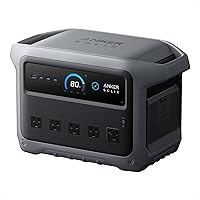
7 Best Anker SOLIX Power Station (November 2026)
The best Anker SOLIX power stations include the Anker SOLIX C2000 Gen 2 Portable Power for whole-home backup planning, the Anker SOLIX C1000 Portable Power Station for everyday outage backup, and the Anker SOLIX C300 DC Portable Power Station for laptops and compact travel.
On this page (13 sections)
- Which Anker SOLIX power station is best?
- Anker SOLIX C2000 Gen 2: best for whole-home backup planning
- Anker SOLIX C1000: best for everyday outage backup
- Anker SOLIX C300 DC: best for laptops and compact travel
- Anker SOLIX C200 DC with solar panel: best for solar charging on short trips
- Anker Prime Charging Station: best for desk charging
- Anker SOLIX C200 DC: best for a simple personal power bank
- Anker SOLIX F3000: best for large RV and emergency loads
- How should you choose an Anker SOLIX portable power station?
- Which Anker SOLIX model is best for a refrigerator?
- Is an Anker SOLIX power station better than an inverter?
- Can you use a power station for an EV?
- What is the best Anker SOLIX power station?
The best Anker SOLIX power station for most backup needs is the Anker SOLIX C2000 Gen 2, with 2,048Wh of capacity, 2,400W rated output and a 4,000W peak. Choose the C1000 for a smaller everyday backup unit, the C300 DC or C200 DC for personal devices, or the F3000 for larger emergency loads.
An Anker SOLIX portable power station can cover very different jobs. A compact DC model may be enough for a laptop and phone, while a larger battery is better suited to a refrigerator, multiple appliances or longer outage planning.
For a broader explanation of battery size, inverter output and recharge methods, read our best portable battery power station guide. If you're deciding between battery storage and a conventional inverter, compare a portable power station vs inverter before you choose.
Our picks at a glance
-
1
 Best for whole-home backup planning
Anker SOLIX C2000 Gen 2 Portable Power
9.7/10 our score
See it on Amazon -
2
 Best for everyday outage backup
Anker SOLIX C1000 Portable Power Station
9.5/10 our score
See it on Amazon -
3
 Best for laptops and compact travel
Anker SOLIX C300 DC Portable Power Station
9.2/10 our score
See it on Amazon
- 4
 Check it
Anker SOLIX C200 DC Portable Power Station
Best for solar charging on short trips - 5
 Best for desk chargingCheck it
- 6
 Check it
Anker SOLIX C200 DC Portable Power Station
Best for a simple personal power bank - 7
 Check it
Anker SOLIX F3000 Portable Power Station
Best for large RV and emergency loads
Which Anker SOLIX power station is best?
The C2000 Gen 2 is the best overall choice here because it combines high capacity, strong output and a more manageable size than the F3000. That balance makes it the easiest starting point for most home backup and camping plans.
The C1000 is the better middle option when you want real outage coverage without the weight and footprint of a 2kWh class unit. It suits households that need to keep essentials running for a few hours rather than planning for a full day or more.
The C300 DC and C200 DC focus on portable device charging rather than appliance backup. They are aimed at laptops, phones, cameras and other personal electronics, not refrigerators or power tools.
Our score weighs specs, features and buyer feedback against what you are shopping for. Capacity, output, portability and charging options all matter, and no single model wins on every one of them.
Think about how you will actually use the unit day to day. A battery that lives in one place for outage cover has different needs from one that rides in a car for camping.
If most of your use is occasional charging, a compact DC model avoids paying for capacity you will rarely draw on. If your priority is a refrigerator or several appliances, the larger AC models give you a safer margin.
Keep the battery topped up before a trip or storm season, and store it where you can reach it quickly if the power goes out. More capacity usually means more weight, so choosing the model that fits your main use usually gives better long term value.
| Product | Best for | Capacity | Output | Size and weight | Our score |
|---|---|---|---|---|---|
| Anker SOLIX C2000 Gen 2 Portable Power | whole-home backup planning | 2,048Wh | 2,400W rated, 4,000W peak | 18.1 x 9.8 x 10.1 in, 41.7 lb | 9.7 |
| Anker SOLIX C1000 Portable Power Station | everyday outage backup | 1,056Wh | 1,800W, 2,400W peak | 14.8 x 8.07 x 11.02 in, 27.6 lb | 9.5 |
| Anker SOLIX C300 DC Portable Power Station | laptops and compact travel | 288Wh | 300W | 4.89 x 7.87 x 4.72 in, 2.8 kg | 9.2 |
| Anker SOLIX C200 DC Portable Power Station | solar charging on short trips | 192Wh | 200W | 7.28 x 3.94 x 4.33 in, 1.9 kg | 9.2 |
| Anker Prime Charging Station | desk charging | 6.38 x 3.11 x 0.71 in, 16.2 oz | 9.1 | ||
| Anker SOLIX C200 DC Portable Power Station | a simple personal power bank | 192Wh | 200W | 3.94 x 7.28 x 4.33 in, 1.9 kg | 9.0 |
| Anker SOLIX F3000 Portable Power Station | large RV and emergency loads | 3,072Wh, expandable to 24kWh | 3,600W | 25.6 x 11.8 x 14.8 in, 91.5 lb | 8.5 |
Anker SOLIX C2000 Gen 2: best for whole-home backup planning
Anker SOLIX C2000 Gen 2 Portable Power: Best for whole-home backup planning
- 2,048Wh capacity
- 2,400W rated output
- 4,000W peak output
- Up to 4kWh expandable capacity
- 800W alternator charging
The C2000 Gen 2 balances high capacity, strong output and a smaller body than similar products. It suits home backup, camping and road trips, including a dual-door refrigerator for up to 32 hours.
Pros
- High capacity
- 4,000W peak output
- Expandable to 4kWh
- 800W alternator charging
Cons
- Heavier than the smaller C200 and C300 models
- More capacity than casual phone and laptop charging requires
The Anker SOLIX C2000 Gen 2 gives you 2,048Wh of capacity and 2,400W of rated output. Its 4,000W peak output gives it more headroom for appliances with higher startup demands than the smaller models in this group.
Anker states that it can power a dual-door refrigerator for up to 32 hours. The maker also gives an optional expansion path to 4kWh, with up to 64 hours of dual-door refrigerator runtime.
The unit measures 18.1 x 9.8 x 10.1 in and weighs 41.7 lb. That makes it far more substantial than the DC models, but it remains smaller and lighter than a large emergency battery such as the F3000.
Six recharge methods are available, including AC and solar. Anker states that it can fully recharge in 58 minutes, while the 800W alternator charging feature can reach a full charge in 3 hours from a car.
Choose it when your backup plan includes a refrigerator, several appliances or longer camping use. The C2000 Gen 2 is less practical if you only need occasional phone and laptop charging.
Anker SOLIX C1000: best for everyday outage backup
Anker SOLIX C1000 Portable Power Station: Best for everyday outage backup
- 1,056Wh capacity
- 1,800W output
- 2,400W peak output
- 600W solar input
- 11 ports
The C1000 is a practical middle choice for outages and camping. Its 1,056Wh capacity, 1,800W output and 600W solar input cover more than basic device charging without the size of the larger models.
Pros
- Balanced capacity and size
- 600W solar recharging
- Car charging cable included
- 11 ports
Cons
- Less capacity than the C2000 Gen 2
- UltraFast charging requires AC input and the Anker app
The Anker SOLIX C1000 is the most balanced choice for many households that need backup power without moving a 3,000Wh-class unit. It stores 1,056Wh and provides 1,800W of output, with a 2,400W peak.
Its 14.8 x 8.07 x 11.02 in body weighs 27.6 lb. That is still portable for camping or a power outage kit, while giving you much more capacity than the C200 DC and C300 DC.
The C1000 has 11 ports and supports up to 600W solar recharging. Anker says it can reach 80% in 43 minutes and a full charge in under an hour with AC input and UltraFast mode enabled through the Anker app.
The included car charging cable makes vehicle charging part of the setup. The C1000 also uses a LiFePO4 battery, and Anker states a 3,000-cycle, 10-year battery life.
Read our Anker SOLIX C1000 power station reviews for a closer look. Choose this model if you want a general-purpose Anker SOLIX portable power station for outages, camping and RV use without stepping up to the F3000.
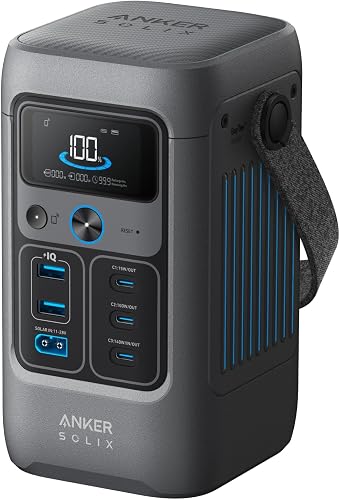
Anker SOLIX C300 DC: best for laptops and compact travel
Anker SOLIX C300 DC Portable Power Station: Best for laptops and compact travel
- 288Wh capacity
- 300W output
- Two 140W two-way USB-C ports
- 7 charging ports
- 100W solar input
The C300 DC focuses on portable DC charging for laptops and other personal devices. It has 7 ports, a 300W output and a 288Wh battery in a compact body.
Pros
- Compact design
- Two 140W USB-C ports
- 100W solar input
- 7 ports
Cons
- Much less capacity than the C1000
- Shoulder strap is sold separately
The Anker SOLIX C300 DC is designed around portable DC charging rather than large appliance backup. It has a 288Wh battery, 300W output and 7 charging ports.
Two 140W two-way USB-C ports make this the stronger compact option for high-powered USB-C devices. The port layout also includes a 100W USB-C port, a 15W USB-C port, two 12W USB-A ports and a 120W car socket.
The C300 DC measures 4.89 x 7.87 x 4.72 in and weighs 2.8 kg. Anker says it is 30% smaller than similar power stations, which may help when space matters in a vehicle or camping kit.
You can recharge it with an 18W or higher USB-C wall charger, a car or a compatible solar panel. Anker recommends a 100W or 60W Anker Solar Panel and says this model is not compatible with the PS30, PS200 or PS400 panels.
The box includes the power station, a 60cm 140W USB-C to C cable, safety manual and warranty information. A shoulder strap is not included.
Anker SOLIX C200 DC with solar panel: best for solar charging on short trips
Anker SOLIX C200 DC Portable Power Station: Best for solar charging on short trips
- 192Wh capacity
- 200W output
- 60W solar panel included
- 5 device charging ports
- Up to 100W solar input
This C200 DC bundle adds a 60W solar panel for short trips and personal electronics. It offers 192Wh, 200W output and 5 device charging ports.
Pros
- 60W solar panel included
- Lightest power station here
- Compact travel design
- 5 charging ports
Cons
- Lower capacity than the C300 DC
- Solar compatibility is limited to the stated panel range
This Anker SOLIX C200 DC bundle includes the power station and a 60W solar panel. Its 192Wh capacity and 200W output are suited to phones, tablets, cameras, drones, laptops and other smaller devices.
The unit has 5 device charging ports: one 100W USB-C port, one 140W USB-C port, one 15W USB-C port and two 12W USB-A ports. It measures 7.28 x 3.94 x 4.33 in and weighs 1.9 kg.
Anker states that wall charging can reach 80% in 50 minutes, while the included 60W solar panel can recharge it in about 4 hours. You can also recharge through a car or the PD 3.1 USB-C port.
The bundle includes a solar-to-XT-60 cable, extension cable and 60cm 140W USB-C to C cable. Anker says the power station is not compatible with the PS30, PS200 or PS400 panels.
Choose this version if having a solar panel in the box matters. If you already own suitable charging equipment and want a simpler package, the other C200 DC version may fit better.
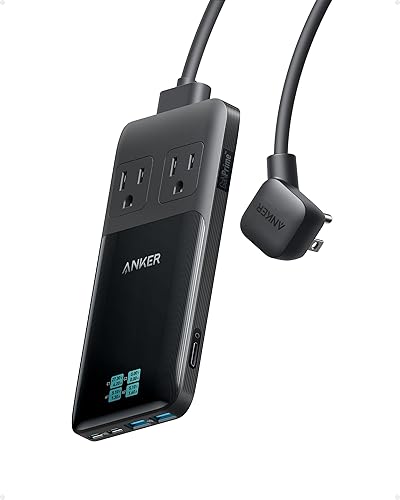
Anker Prime Charging Station: best for desk charging
Anker Prime Charging Station: Best for desk charging
- 140W USB-C output
- 2 AC outlets
- 2 USB-C ports
- 2 USB-A ports
- Smart display
The Anker Prime Charging Station is for organizing powered devices at a desk or travel setup. It is a 6-in-1 power strip, not a battery power station for outages.
Pros
- 140W USB-C charging
- 6 charging connections
- Slim 0.7 in design
- Smart display
Cons
- Does not store backup power
- Total connected-device wattage must stay within 1,000W
The Anker Prime Charging Station is different from every battery model here. It is a 6-in-1 travel power strip with two AC outlets, two USB-C ports and two USB-A ports, so it organizes charging at a desk or travel setup but does not store energy for an outage.
One USB-C port can deliver up to 140W. The USB ports support 100–240V input, and the total wattage of connected devices must not exceed 1,000W.
Its slim body measures 6.38 x 3.11 x 0.71 in and weighs 16.2 oz. A smart display shows power information when the unit is connected to a power supply.
The box includes a 5 ft detachable cord and welcome guide. The product is not a wireless pad or portable battery, and it does not provide backup power when the wall outlet loses power.
Choose it for a multi-device desk, hotel room or travel kit. Choose a true Anker SOLIX battery power station for camping, refrigerator backup or an outage.
Anker SOLIX C200 DC: best for a simple personal power bank
Anker SOLIX C200 DC Portable Power Station: Best for a simple personal power bank
- 192Wh capacity
- 200W output
- 140W two-way USB-C port
- Up to 100W solar input
- 3,000-cycle LFP battery
This C200 DC version is a compact personal power station with 192Wh, 200W output and a 140W two-way USB-C port. It includes a USB-C to C charging cable but no solar panel.
Pros
- Compact size
- 140W USB-C charging
- 3,000-cycle LFP battery
- Up to 100W solar input
Cons
- Solar panels are not included
- Less capacity than the C300 DC
This Anker SOLIX C200 DC has the same 192Wh capacity and 200W output class as the solar-panel bundle, but the package includes a USB-C to C charging cable instead of a solar panel.
Its 140W two-way USB-C port supports faster charging, while the full port layout includes one 100W USB-C port, one 140W USB-C port, one 15W USB-C port and two 12W USB-A ports.
The C200 DC measures 3.94 x 7.28 x 4.33 in and weighs 1.9 kg. Anker states that its LiFePO4 battery supports 3,000 cycles and that the unit accepts up to 100W solar input.
You need an 18W or higher USB-C PD charger for basic recharging. A 140W charging port is required for full-speed charging, and compatible solar panels must use the stated 11–28V range with an XT60 connector.
Choose this model for a compact personal power source when a solar panel is not needed in the box. For a longer trip with built-in solar charging, choose the C200 DC bundle above.
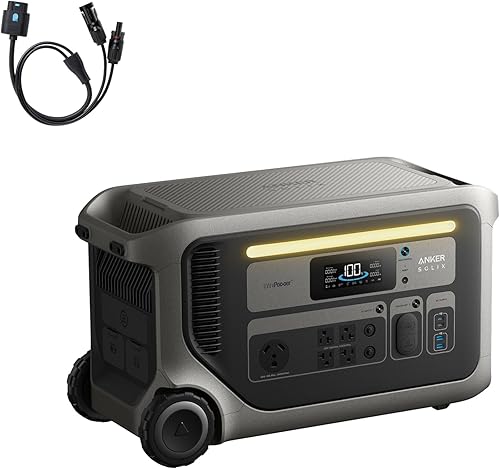
Anker SOLIX F3000: best for large RV and emergency loads
Anker SOLIX F3000 Portable Power Station: Best for large RV and emergency loads
- 3,072Wh capacity
- 3,600W output
- 2,400W solar recharging
- Expandable to 24kWh
- 120V and 240V output
The F3000 is the largest option here for power outages, RVs and emergencies. Its 3,072Wh capacity, 3,600W output and expandable storage favor longer backup over easy carrying.
Pros
- Largest capacity
- Expandable to 24kWh
- 2,400W solar recharging
- 120V and 240V output
Cons
- Heaviest model here
- Large footprint for casual camping
The Anker SOLIX F3000 has the largest battery in this comparison at 3,072Wh. It delivers 3,600W of output and can expand to 24kWh, making it the better match for extended outage plans, RV use and larger appliance loads.
Anker states that the F3000 can run a 190W refrigerator for 42 hours. It also gives the unit 120V output, with 240V output available when two power stations are paired for demanding appliances.
The F3000 supports up to 2,400W of solar recharging and 3,600W of pass-through charging from a 120V generator. Anker also describes combined fuel-generator and solar charging up to 6,000W.
The trade-off is size. It measures 25.6 x 11.8 x 14.8 in and weighs 91.5 lb, so it is better treated as a large backup unit than a casual carry-on power station.
The box includes the power station, AC charging cable, high-voltage solar charging cable, user manual, warning notice and warranty card. Choose it when storage and output matter more than portability.
How should you choose an Anker SOLIX portable power station?
Choose by the device's running wattage first, then compare battery capacity for the runtime you need. A power station with enough watt-hours can still shut down if the connected load exceeds its output limit.
Capacity is measured in watt-hours. The C200 DC stores 192Wh, the C300 DC stores 288Wh, the C1000 stores 1,056Wh, the C2000 Gen 2 stores 2,048Wh and the F3000 stores 3,072Wh.
Output is measured in watts. The compact C200 DC and C300 DC are aimed at personal electronics, while the C1000, C2000 Gen 2 and F3000 provide more room for appliance loads.
Solar input affects how quickly you can restore the battery away from an outlet. The C200 DC accepts up to 100W, the C1000 accepts up to 600W, the C2000 Gen 2 supports solar charging as part of its six recharge methods and the F3000 supports up to 2,400W.
Which Anker SOLIX model is best for a refrigerator?
The C2000 Gen 2 is the best middle ground choice for refrigerator backup, while the F3000 suits a larger emergency setup. The C1000 can work for smaller backup plans, but runtime depends on the refrigerator power use and cycling.
A refrigerator does not draw power at a steady rate all day. It cycles on and off, and the compressor can ask for more power at startup than it uses while running.
That is why output matters alongside capacity. A battery may have enough watt hours on paper, yet still shut down if starting demand is above what the inverter can supply.
The C2000 Gen 2 gives 2,400W rated output with a 4,000W peak. That headroom helps with startup demand and leaves room for lights, a phone charger or a small fan.
Anker gives the C2000 Gen 2 a dual door refrigerator runtime of up to 32 hours. That figure assumes the stated test load, so a thirstier fridge will drain it faster.
Anker gives the F3000 a 42 hour runtime for a 190W refrigerator. Its larger 3,072Wh capacity explains the longer run time, and its higher output suits bigger emergency loads.
The C1000 sits below both at 1,056Wh and 1,800W output. It can support a refrigerator in a smaller plan, but expect a shorter runtime and less spare capacity.
For more refrigerator focused guidance, see our comparison of the best portable power stations for refrigerators. Leave room for startup demand and keep the actual wattage in mind.
Check the label on your fridge before you buy. You want running watts and, if listed, starting watts, to compare with rated and peak output.
In daily use, keep air flowing around the unit and avoid covering vents. Plan for other household needs too, since a fridge never runs alone in a real outage.
If you expect a long outage, expansion or a larger model may be worth it from the start. Buying for the runtime you need is easier than replacing a unit that runs out too soon.
Is an Anker SOLIX power station better than an inverter?
A battery power station is usually the simpler choice when you need stored energy, portable use and built-in charging options. An inverter is a different setup that converts battery power, but the battery, wiring and charging system may be separate.
The Anker Prime Charging Station is not an inverter or battery backup. It distributes wall power through AC and USB ports, so it cannot replace the C1000, C2000 Gen 2 or F3000 during an outage.
Read our portable power station vs inverter comparison if you are planning a fixed backup system. The right choice depends on whether you need portability, stored capacity, higher output or a permanent installation.
Can you use a power station for an EV?
A portable power station is not automatically an EV charging solution. EV charging places a much larger demand on stored energy than phones, laptops or small appliances, so check vehicle and charging requirements first.
Most units in this comparison are built for home backup, camping and personal electronics. Their capacities run from under 200Wh to just over 3,000Wh, useful for household loads but small beside EV needs.
EV charging also depends on connector type and the rate your car accepts. A power station may have AC output, yet still not match what a vehicle needs to charge at a useful speed.
That mismatch is the main reason to pause before buying. You could spend a lot on a large battery and still not get the charging behaviour expected from the car.
Our guide to a portable power station for EV charging explains the limits and the questions to ask. It covers wattage, connectors and cable requirements before you commit.
For another large capacity comparison, see our guide to Jackery power station 2000 models. That is useful if you are comparing big home backup units across brands.
If your main goal is topping up a phone or laptop on a trip, a compact DC model is often enough. If your goal is emergency vehicle charging, you need a much more specific plan.
Look at your vehicle manual first and note the charging detail it specifies. Then compare that with power station output rather than relying on general claims.
Also think about where charging would happen. A home garage, a campsite and a roadside stop place different demands on cables, space and time.
The honest trade off is cost and weight for a very narrow use. For most people, a power station makes more sense for home and camping backup than for regular EV charging.
What is the best Anker SOLIX power station?
The C2000 Gen 2 is the best Anker SOLIX power station for most serious backup plans because it combines 2,048Wh, 2,400W rated output, a 4,000W peak and expansion to 4kWh. That mix suits a home that wants refrigerator cover plus room for other essentials.
Pick the C1000 when you want a smaller all purpose unit. It gives 1,056Wh and 1,800W output in a 27.6 lb body, easier to store and move for outages, camping and RV use.
Pick the C300 DC or C200 DC for personal devices. Their compact size and USB C charging suit laptops, phones and cameras, and they travel far more easily than larger AC models.
Pick the F3000 for maximum capacity. At 3,072Wh with expansion to 24kWh and 3,600W output, it is aimed at larger RV and emergency loads where runtime matters most.
The right choice comes down to the load you plan to run first. Add up running watts for essentials, then check output can handle startup demand as well.
Capacity then tells you how long that load can run. A bigger battery helps, but a fridge that cycles or a heater that runs constantly will change the result.
Recharging method matters too. Solar input, vehicle charging and fast AC charging each suit a different routine, so match the method to how you will top up.
Size and weight should not be an afterthought. A unit that is hard to move may be stored in the wrong place when needed, so plan a fixed spot with cables ready.
If long battery life is your main concern, compare our best LiFePO4 power station guide. LiFePO4 chemistry is common across these models, and cycle life affects how the unit ages.
For a different use, our guide to the best portable power stations for TVs covers output and runtime. A TV load is simpler than a fridge, but port layout and cable length still matter.
Set up is worth a little time before you need the unit. Charge it fully, test main devices one by one, and keep the manual and cables together.
Care between uses is simple. Store at a sensible charge level, keep vents clear, and check the battery before storm season or a long trip.
The trade off across this range is portability against runtime. Compact models win on ease of carrying, while larger models win on how long they keep essentials running.
Our top 3 picks at a glance
-
1
Best for whole-home backup planning
Anker SOLIX C2000 Gen 2 Portable Power
9.7/10 our score
See it on Amazon -
2
Best for everyday outage backup
Anker SOLIX C1000 Portable Power Station
9.5/10 our score
See it on Amazon -
3
Best for laptops and compact travel
Anker SOLIX C300 DC Portable Power Station
9.2/10 our score
See it on Amazon
Frequently asked questions
What is the best Anker SOLIX power station for home backup?
The Anker SOLIX C2000 Gen 2 is the best Anker SOLIX power station for many home backup plans because it has 2,048Wh, 2,400W rated output and a 4,000W peak. The F3000 suits larger loads and longer backup, while the C1000 takes less space.
Which Anker SOLIX power station is best for a refrigerator?
The C2000 Gen 2 is the strongest fit here for refrigerator backup because Anker gives it a dual-door refrigerator runtime of up to 32 hours. The F3000 is also designed for larger emergency loads and can run a 190W refrigerator for 42 hours.
What is the difference between an Anker SOLIX power station and a charging station?
An Anker SOLIX power station stores energy in a battery for use away from an outlet. The Anker Prime Charging Station distributes wall power through AC and USB ports, but it is not a portable battery and cannot provide outage backup by itself.
Is the C200 DC or C300 DC better for travel?
The C200 DC is lighter at 1.9 kg and the bundle includes a 60W solar panel. The C300 DC has more capacity at 288Wh, 300W output and two 140W USB-C ports, so it fits heavier laptop and personal-device charging.