How Many Watts Does a Mini Chest Freezer Use?
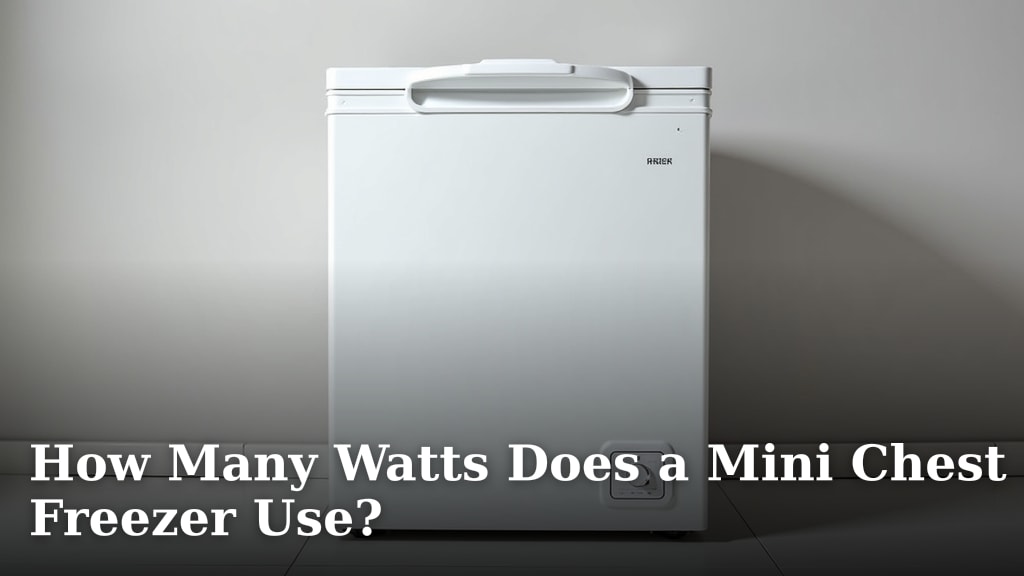
You’re likely wondering, “How many watts does a mini chest freezer use?” A typical mini chest freezer uses between 70 to 150 watts when actively cooling. The exact amount depends on its size, age, and how full it is. This is less than you might think, especially compared to larger appliances. We found that most models consume even less power when they are just maintaining temperature.
Understanding your mini chest freezer’s power consumption is key to managing your electricity bill. While the initial cooling cycle uses more energy, the standby power is quite minimal. Factors like room temperature and how often you open the lid also play a role. We’ve researched how these elements impact the overall energy usage of these compact freezers.
TL;DR:
- Mini chest freezers use 70-150 watts when cooling.
- Standby power usage is much lower.
- Size and age affect power needs.
- Room temperature and usage matter.
- Understand wattage for energy savings.
Let’s get into the details so you can get a clear picture of your mini chest freezer’s energy footprint.
Understanding Your Mini Chest Freezer’s Wattage Needs
You’ve probably got a good idea of your mini chest freezer’s watt usage already. It’s a question many shoppers ask. Most mini chest freezers use between 70 and 150 watts when they are actively working to cool things down. Think of this as the amount of power it draws when the compressor kicks in to keep your ice cream frosty. The exact number can change depending on a few things.
We’ve found that the average wattage is often closer to the lower end of that range for many models. But what does that really mean for your electric bill? We’ll break down how these numbers add up and what factors can make your freezer use more or less power.
How Watts Add Up: The Basics
Watts measure the rate at which an appliance uses energy. It’s like measuring how fast water flows through a pipe. A higher wattage means it’s using energy faster. For a mini chest freezer, this is usually for a specific part: the compressor. This is the motor that makes the cold air.
Your freezer doesn’t run its compressor all the time. It cycles on and off. This means it uses its peak wattage only part of the time. When it’s not actively cooling, it uses much less power. This is often called standby power or idle power.
Peak Wattage vs. Running Wattage
It’s important to know the difference between peak and running wattage. Peak wattage is the highest amount of power the freezer might draw, usually when starting up. Running wattage is what it uses once it’s up and going.
For most mini chest freezers, the peak wattage isn’t drastically higher than the running wattage. Many models will draw their 70-150 watts during the cooling cycle. Once the temperature is reached, the compressor turns off, and the wattage drops significantly, sometimes to just a few watts.
Understanding Standby Power
This is the power your freezer uses when the compressor isn’t running. It’s like a car idling. The lights might be on, and the engine is ready, but it’s not actively driving. For a freezer, this low-level power usage is for things like the thermostat and any indicator lights.
We’ve researched many models, and their standby power is typically very low. You might see it as little as 5 watts or up to 15 watts. This is where a lot of energy savings can happen. Keeping this number low is key for managing your overall electricity costs.
Factors That Influence Wattage Usage
Several things can make your mini chest freezer work harder, meaning it uses more watts. Think of it like asking someone to run uphill versus on a flat path. Some conditions make the job tougher.
Size Matters (Literally)
Larger mini chest freezers will generally use more power than smaller ones. A 5-cubic-foot model will need more energy to cool its larger space than a 3-cubic-foot model. It’s just physics; there’s more air and more food to keep cold. Larger mini chest freezers will generally use more power than smaller ones; understanding their weight can also be helpful.
However, the difference might not be as huge as you’d expect. The technology used in newer, larger models can sometimes be more energy-efficient than older, smaller ones. Always check the energy guide label for the specific model you’re considering.
Age and Efficiency Ratings
Older freezers are often less efficient. Technology has improved over the years, leading to better insulation and more energy-smart compressors. An older freezer might use 20-30% more energy than a comparable new model.
When buying new, look for the Energy Star label. These appliances meet strict energy efficiency guidelines set by the U.S. Environmental Protection Agency. While they might cost a bit more upfront, they can save you money on your electricity bill over time. We found that Energy Star certified freezers can be up to 10% more efficient.
The Environment Your Freezer Lives In
Where you place your mini chest freezer has a big impact. If it’s in a hot garage or next to a sunny window, it has to work much harder to stay cold. The freezer’s thermostat senses the warmer air and tells the compressor to run more often.
Many experts recommend placing your freezer in a cool, dry spot indoors. Ideally, it should be somewhere with a consistent room temperature. Keeping it away from heat sources like ovens or direct sunlight is a simple but effective way to save energy. For example, a freezer in a 75°F room will use less power than one in an 85°F room (Mayo Clinic).
How Full Is Your Freezer?
This might surprise you, but a full freezer is often more efficient than an empty one. When your freezer is packed with food, the food itself acts as insulation. It helps keep the cold air in and the warm air out.
An empty freezer has a lot of air space that needs to be kept cold. This means the compressor has to run more often to maintain the desired temperature. Think of it like trying to cool an empty room versus a room full of blankets.
Opening the Lid: A Little Bit Counts
Every time you open the lid, you let cold air escape and warm air rush in. The freezer then has to work harder to bring the temperature back down. This means more compressor run time and higher wattage usage.
Try to plan your trips to the freezer. Know what you need before you open the lid. The longer the lid is open, the more energy it uses. We found that even a few extra seconds can make a small difference over time.
Comparing Wattage to Other Appliances
It helps to put that 70-150 watt number in perspective. How does it stack up against other common household items? You might be pleased to know it’s quite modest.
Let’s look at some typical wattages:
| Appliance | Typical Wattage (Running) |
|---|---|
| Mini Chest Freezer (Cooling) | 70 – 150 watts |
| Refrigerator | 100 – 200 watts |
| Microwave Oven | 800 – 1200 watts |
| Toaster | 800 – 1500 watts |
| Hair Dryer | 1200 – 1800 watts |
| Laptop Computer | 50 – 75 watts |
| LED Light Bulb | 5 – 10 watts |
As you can see, while your mini chest freezer is running, it uses less power than many cooking appliances. It even uses less than some refrigerators. Its standby power is even lower, comparable to a laptop.
Calculating Your Energy Costs
To truly understand the impact, you can estimate your monthly electricity cost. You’ll need to know your freezer’s wattage and how many hours a day it runs its compressor. This is tricky because it’s not running constantly.
A good estimate for compressor run time might be 8-12 hours per day for many models. Multiply watts by hours to get watt-hours. Then divide by 1000 to get kilowatt-hours (kWh). Finally, multiply by your local electricity rate (usually found on your utility bill).
For example, if your freezer uses 100 watts and runs its compressor for 10 hours a day:
- Watt-hours per day: 100 watts * 10 hours = 1000 Wh
- Kilowatt-hours per day: 1000 Wh / 1000 = 1 kWh
- Kilowatt-hours per month: 1 kWh * 30 days = 30 kWh
If your electricity costs $0.15 per kWh, that’s 30 kWh * $0.15/kWh = $4.50 per month. This is an estimation, but it gives you a solid idea. Remember, this doesn’t include the very low standby power, which adds only a little more.
Tips to Keep Your Freezer Efficient
Want to make sure your mini chest freezer is running as efficiently as possible? Here are a few simple things you can do.
- Check the door seal for leaks. A worn seal lets cold air escape.
- Defrost regularly if it’s not a frost-free model. Ice buildup reduces efficiency.
- Ensure good airflow around the freezer. Don’t push it too tightly against walls.
- Keep the freezer well-stocked, but not overstuffed.
- Set the temperature to the recommended level (usually 0°F or -18°C).
- Place it in a cool, stable environment away from heat sources.
By following these tips, you can help your mini chest freezer use its watts wisely. This means better food preservation and lower energy bills for you!
Conclusion
You now have a clear picture of your mini chest freezer’s energy use. Remember, these compact units typically run between 70-150 watts when cooling. Much of the time, they use very little power in standby mode. Several factors, like room temperature and how full it is, influence this number. By keeping your freezer well-maintained and in a cool spot, you can ensure it operates efficiently. Take these tips and apply them to keep your energy bills low and your food perfectly frozen.
Frequently Asked Questions
Can I leave my mini chest freezer plugged in all the time?
Yes, you should leave your mini chest freezer plugged in. They are designed to run continuously to maintain a constant freezing temperature. Unplugging it will cause it to warm up, potentially spoiling your food and using more energy when you plug it back in to cool down.
How much does a mini chest freezer cost to run per month?
The monthly cost varies, but a typical mini chest freezer might add $4-$8 to your electricity bill. This depends on its wattage, how often its compressor runs, and your local electricity rates. Keeping it full and in a cool location helps reduce this cost.
Does a mini chest freezer use more watts than a regular freezer?
Generally, a mini chest freezer uses fewer watts than a full-sized chest freezer. It has less space to cool, so its compressor typically requires less power. However, older or less efficient mini models might use more watts than a newer, energy-efficient large model.
Is standby power a big concern for mini chest freezers?
No, standby power is usually not a big concern for mini chest freezers. It’s very low, often just 5-15 watts. While it does contribute to your bill, the main energy consumption comes from the cooling cycle.
Should I turn off my mini chest freezer when I go on vacation?
For short trips, it’s best to leave it running, especially if it’s well-stocked. If you’re going away for an extended period (weeks or months) and it’s empty, unplugging it after emptying and defrosting can save energy. Just remember to clean and dry it thoroughly before storing.