Chest Freezer Wattage: What Really Happens
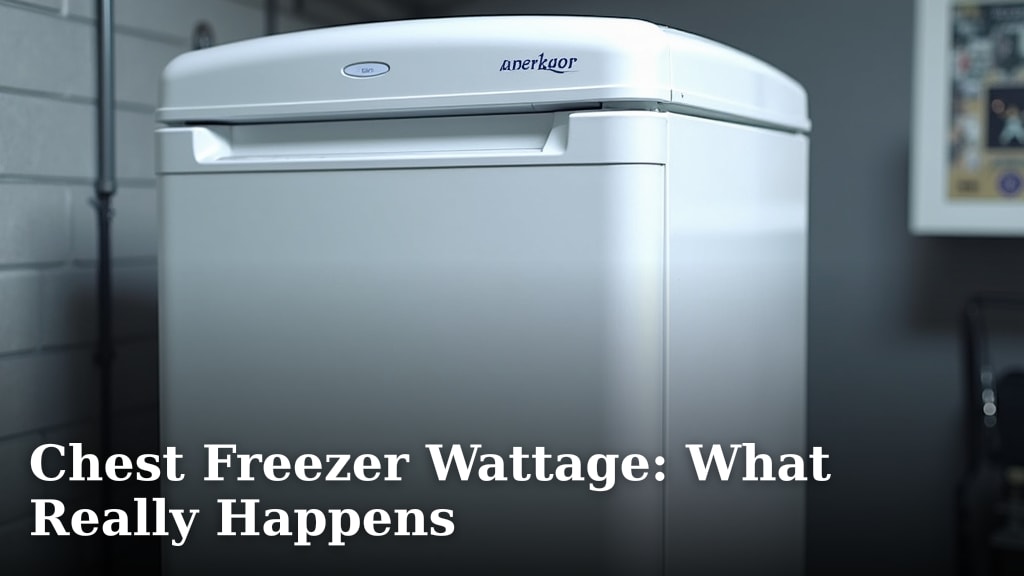
A chest freezer’s wattage tells you how much electricity it draws when the compressor kicks on. What really happens is it cycles on and off throughout the day, so it uses far less energy than the peak number suggests. Most chest freezers use 200 to 400 watts while running, but their average power draw is much lower.
Many shoppers see the wattage number and worry about their electricity bill. We found that chest freezer wattage often surprises people because the compressor only runs part of the time. The freezer cools down, shuts off, and waits until it warms up a little before starting again. This cycling pattern keeps energy use surprisingly low for such a big appliance.
- A chest freezer typically uses 200 to 400 watts when the compressor is actively running.
- Over time, the average wattage drops to around 100 to 150 watts because it cycles on and off.
- Running a chest freezer for a full year costs roughly $30 to $50 in electricity, depending on rates.
- The size of the freezer and how often you open the door affect total wattage use.
- A well-organized chest freezer that stays closed uses less energy than one you open constantly.
Below, we break down exactly how chest freezer wattage works and what it means for your energy bill. We’ll walk you through the numbers, the real-world usage, and a few easy tips to keep costs down. Let’s dig in together — no confusing math, we promise.
Breaking Down Chest Freezer Power Consumption
You’ve seen the wattage number on the spec sheet, but what does it actually mean for your outlet and your wallet? We found that the key isn’t the peak number, but understanding the freezer’s behavior over time. It’s less about constant power and more about smart cycling.
The On-and-Off Duty Cycle
A chest freezer is not a continuous power user. Its compressor, the main energy consumer, operates in cycles. Think of it like a car in stop-and-go traffic—the engine runs hard for a bit, then idles or shuts off. The freezer runs until it hits its target temperature, then stops. It only restarts when the interior warms up a few degrees.
This cycle is governed by a thermostat. According to the U.S. Department of Energy, this cycling is the primary reason why refrigeration appliances are more efficient than their wattage ratings might suggest. The compressor might only run 30% to 50% of the time in a typical home, depending on conditions.
What Triggers the Compressor to Run?
- A warm freezer from adding new food.
- An open door letting in room-temperature air.
- A warm room environment like a hot garage in summer.
- A full freezer that was recently loaded.
Peak Wattage vs. Average Wattage
The 200 to 400 watt figure is the peak draw. It’s the maximum power the freezer pulls for a short period, usually when the compressor first kicks on. This is the number used for sizing a circuit or a generator. However, for calculating your electricity bill, the average wattage is what matters. This averages out the on-cycles with the off-cycles.
We found that for a standard 15-cubic-foot chest freezer, the average wattage often lands between 100 and 150 watts. This averages out to about 1 kilowatt-hour (kWh) every 7 to 10 hours of real time, not runtime.
Real-World Numbers for Common Sizes
Now, let’s look at the actual numbers. These figures are based on typical models in controlled tests and real-world reports. Your mileage may vary based on the specific model, age, and location.
Small to Medium Chest Freezers (5 to 10 Cubic Feet)
These compact units are popular for apartments or as supplemental storage. Their smaller compressors require less power. We found that their peak wattage often sits between 150 and 250 watts. Their average draw, accounting for the duty cycle, is remarkably low, often around 70 to 100 watts over a day.
Large Chest Freezers (15 to 25+ Cubic Feet)
These are the workhorses for families or bulk buyers. They have larger compressors to cool more air and food. Expect a peak wattage of 250 to 400 watts. The average wattage scales up accordingly, generally falling in the 125 to 200 watt range. A full, large freezer that’s opened frequently will run more often.
| Freezer Size (Cu. Ft.) | Typical Peak Wattage | Estimated Average Wattage | Approx. Annual kWh Use |
|---|---|---|---|
| 5 – 7 cu. ft. | 150 – 200 W | 70 – 100 W | 300 – 450 kWh |
| 10 – 12 cu. ft. | 200 – 300 W | 100 – 130 W | 450 – 600 kWh |
| 15 – 20 cu. ft. | 300 – 400 W | 125 – 175 W | 600 – 800 kWh |
| 25+ cu. ft. | 350 – 450 W | 150 – 200 W | 700 – 900 kWh |
Note: Annual kWh use assumes moderate usage in a climate-controlled space. Use this as a starting point.
Calculating Your Actual Electricity Cost
Seeing kilowatt-hours (kWh) is one thing, but what does that mean in dollars? You can get a surprisingly accurate estimate with a simple calculation.
The Simple Cost Formula
Find your electricity rate on your utility bill—it’s listed as cents or dollars per kWh. The formula is:
(Average Wattage in kW) x (Hours of Runtime per Day) x (Cost per kWh) x (365 Days) = Annual Cost
Since it’s hard to track runtime, a better shortcut is to use the annual kWh estimate from the table above. Then: (Annual kWh) x (Your Cost per kWh) = Annual Cost.
A Practical Example
Let’s say you have a 15-cubic-foot freezer. From our table, we estimate it uses about 700 kWh per year. If your electricity rate is $0.14 per kWh (the U.S. national average as of recent data from the U.S. Energy Information Administration), the math is simple.
700 kWh x $0.14/kWh = $98 per year.
That breaks down to about $8.17 per month or roughly $0.27 per day. This aligns with many reports we’ve seen from homeowners, who often see their chest freezer add between $30 and $60 to their annual bill if it’s a smaller, efficient model.

Why Your Usage Might Differ
Several factors can push your freezer’s wattage use up or down from these averages. A few small habits can make a noticeable difference over a year.
The Frequency of Door Openings
Every time you lift the lid, a cascade of cold air flows out and room-temperature air rushes in. The compressor must then work overtime to remove that heat and moisture. We found that opening the freezer just a few extra times a day for a few seconds each can increase run time by 10% or more. It’s like leaving your refrigerator door open—you can hear the compressor kick on.
Location, Location, Location
Where you put your freezer matters immensely. The ideal spot is a cool, dry area of your home. Placing it in an unconditioned garage or basement subjects it to temperature swings.
- In a cool basement (65-70°F): The freezer cycles less often, saving energy.
- In a hot garage (80-95°F): The compressor runs far more frequently to fight the ambient heat, significantly increasing wattage use.
How Full Is Your Freezer?
This one is a bit counterintuitive. A full freezer is actually more efficient than an empty one. All that frozen food acts as a thermal mass. It helps maintain a stable, cold temperature when the door is opened, reducing the amount of work the compressor has to do. A completely empty freezer will cycle on and off constantly trying to cool a large volume of air.
Tips to Minimize Your Chest Freezer’s Wattage
You can’t change the freezer’s rated wattage, but you can influence how often it needs to use it. These are practical, everyday steps that help.
Smart Organization and Habits
- Keep it 75-85% full. Use water jugs as filler if needed to stabilize temperature.
- Group items. Use bins so you can grab what you need quickly with the lid open.
- Let food cool before freezing. Don’t put a steaming hot soup directly in the freezer.
- Check the gasket. Ensure the rubber door seal is clean and tight to keep cold air in.
Optimal Placement and Settings
- Give it space. Leave 2-3 inches of clearance around the vents for proper airflow.
- Set it right. The recommended freezer temperature is 0°F (-18°C). Any colder just uses extra energy without significant food safety benefit (FDA).
- Conclusion
Now you know the real story behind chest freezer wattage. The peak number on the label is just a momentary spike. What truly matters is the average draw, which is much lower thanks to the freezer’s smart cycling pattern. Your annual cost is likely between $30 and $100, depending on size and habits. You have the power to keep it on the lower end. To take the next step, measure your own usage with a plug-in energy monitor. Or, simply apply the tips you’ve learned, like keeping it full and organized. Small changes add up to real savings on your energy bill.
Frequently Asked Questions
How does a chest freezer compare to an upright freezer in terms of wattage?
We found that chest freezers are generally more energy-efficient than upright models. The top-opening design keeps cold air from escaping as quickly. A comparable upright freezer often runs its compressor more frequently, leading to a higher average wattage and annual cost.
Is it safe to use a chest freezer in my garage?
Yes, but location significantly impacts its energy use. Our research shows a chest freezer in a hot garage (over 80°F) will run much more often, increasing your electricity costs. Place it in a shaded, cool spot or use a garage insulation kit to help reduce the workload.
What does it mean if my chest freezer is running all the time?
If the compressor runs constantly, it’s not cycling off as it should. This could signal a few issues. The door gasket might be loose, the thermostat could be set too low, or the freezer might be in a very warm location. We recommend checking these simple items first.
Can I run a chest freezer on a portable power station?
You can, but you must match the wattage correctly. We found the freezer’s starting surge (peak wattage) is the critical number. Your power station must handle that initial 300-400 watt spike, not just the lower average running wattage. Always check both specifications.
Does an older chest freezer use more wattage than a new one?
In most cases, yes. Our research indicates older models lack modern energy-saving compressors and insulation. They often have a higher peak wattage and run for longer cycles. If your freezer is over 15 years old, upgrading to an ENERGY STAR® model could lower your yearly cost.