Chest Freezer vs Upright Freezer Efficiency: Which Is Better? (October 2026)
Chest freezers often hold cold air better when opened, but the exact models’ annual energy use decides which is more efficient. Compare kilowatt-hours per year at similar capacities, then consider room temperature, door openings and how much food you store.
On this page (9 sections)
- Which is more efficient, an upright or chest freezer?
- How should you compare freezer energy use?
- What conditions change a freezer's electricity use?
- Do the two chest freezers here have an efficiency advantage?
- When should you choose a chest freezer?
- When should you choose an upright freezer?
- What is the best way to reduce freezer electricity use?
- Which freezer should you pick for lower electricity use?
- Sources
Chest freezers often hold cold air better when opened, but the exact models’ annual energy use decides which is more efficient. For chest freezer vs upright freezer efficiency, compare annual kilowatt-hours for similar-capacity models, then factor in your room and opening habits.
A top lid lets you reach down into a chest, while an upright has a front door and shelves. Those layouts affect access, but they don't tell you how much electricity a specific freezer will use.
The two chest freezers below have capacities of 7.0 and 3.5 cubic feet. Their annual energy figures aren't available here, so you can't use them to declare an energy winner over an upright.
 Best for larger bulk storage
FRIGIDAIRE EFRF7003-BLACK Chest Deep Freezer
Which is more efficient, an upright or chest freezer?
Neither shape guarantees the lower electricity use for every model. Chest freezers have a design advantage when opened because cold air tends to stay lower in the cabinet, while an upright door lets cold air spill out more readily.
That difference is only one part of energy use. Cabinet size, insulation, compressor design, temperature settings and surrounding room conditions all affect how much power a model uses.
Start with the energy label or manufacturer information for the exact freezers you're considering. Look for annual energy use in kilowatt-hours, or kWh, and compare models with similar storage capacity.
Does cold air staying inside save electricity?
A chest can lose less cold air during a quick opening because its lid lifts from the top. The upright's front door exposes more of the cabinet opening, so some cold air can fall out.
This is a general design tendency, not a measurement of a particular model's yearly use. A well-insulated upright may use less energy than a larger or less efficient chest.
How often you open the freezer matters too. If you take items out several times a day, a layout that helps you find food quickly may reduce time with the lid or door open.
How should you compare freezer energy use?
Compare annual kWh for similar-size models, then estimate the cost using your electricity rate. Capacity and yearly energy use together help show whether one freezer offers more storage for its power use.
If annual energy use is shown as a yearly figure, divide it by 12 for a rough monthly estimate. To estimate cost, multiply the annual kWh by the per-kWh rate on your electric bill.
Don't compare a small chest with a large upright and attribute the difference to freezer shape. Match capacities as closely as possible, and compare the same type of energy figure for both models.
For more detail on what to check before choosing a chest, see our guide to comparing chest freezers by energy efficiency. For a running-cost estimate, use how much a chest freezer costs to run.
Why voltage does not show annual consumption
Voltage is the electrical supply a freezer uses, not its total energy use over time. If your unit trips a breaker, see chest freezer breaker troubleshooting.
The Frigidaire chest is listed at 120 volts and the Midea at 115 volts, but those values don't tell you which one uses less electricity. For a 12-volt model, see 12-volt chest freezer wattage.
Look for annual kWh, or a comparable energy-use figure, for each model. If it isn't available, treat energy use as unknown rather than guessing from voltage or cabinet shape.
What conditions change a freezer's electricity use?
Room temperature, thermostat settings, opening frequency and food load can all affect consumption. Keep the freezer in an appropriate location and avoid making it work harder than needed.
A hot garage can make a freezer run more often as it works to maintain its internal temperature. A cold room can also fall outside some models' operating ranges, so check the permitted ambient temperatures before installing a freezer there.
Set the temperature to the level recommended in the manual. A colder setting than you need can increase energy use without improving how you organize food.
A nearly empty freezer may have more air to cool after each opening, while an overcrowded one can block airflow or make items difficult to find. Follow the manual's guidance on loading and keep space around vents clear.
Do the two chest freezers here have an efficiency advantage?
The available details don't show annual kWh for either chest, so they can't be ranked against an upright by electricity use. Their listed capacities and features can still help you choose a size and layout.
The FRIGIDAIRE EFRF7003-BLACK Chest Deep Freezer holds 7.0 cubic feet and includes a removable wire basket, seven thermostat settings and an exterior defrost drain. For a large chest freezer wattage estimate, see the guide.
It may fit bulk storage needs, but you still need a comparable annual energy figure to judge efficiency.
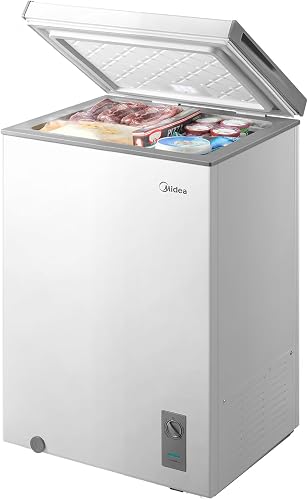
The Midea 3.5 Cu.ft Chest Freezer is a smaller option for a household of 1 to 3 people or as a second freezer. For a medium chest freezer wattage estimate, see the guide.
It can switch between fridge and freezer modes and is designed for garage use across stated temperature ranges, though those features don't guarantee its yearly energy use.
For a different way to plan freezer use, compare energy-efficient top-freezer refrigerators. A refrigerator-freezer may suit you if you need fresh-food storage as well as frozen space.
When should you choose a chest freezer?
Choose a chest when open storage and fewer cold-air losses during brief openings fit your routine. Check the model's annual energy use before treating it as the lower-energy option.
A chest can work well for bulk packs, meal portions and foods you don't need to grab often. A removable basket, like the one included with the Frigidaire and Midea models here, can keep small items near the top.
Plan for the top lid's swing and the reach needed to access the bottom. If deep storage leads you to leave the lid open while searching, the design's potential advantage may not match your use.
When should you choose an upright freezer?
Choose an upright when shelves and front access help you find food quickly. Its easier organization can make daily use simpler, even if a specific upright uses more energy than a comparable chest.
Shelves let you separate meals, vegetables and ingredients. That arrangement can be useful if several people use the freezer or if you rotate through smaller packages often.
Check the door swing, shelf spacing and annual kWh figure. An upright that fits your habits and room may be a better choice than a chest whose storage is harder to reach.
What is the best way to reduce freezer electricity use?
Keep the freezer at its recommended setting, limit unnecessary openings and maintain the door seal. Simple habits help the appliance hold its temperature without extra work.
Let hot food cool safely before placing it in the freezer, and avoid blocking interior vents. Keep the exterior ventilation space clear as directed by the manual.
Open the door or lid with a plan, then close it promptly. Labeling food and keeping frequently used items together can shorten the time you search.
Check the seal for dirt or damage, and clean the freezer as the manual directs. If frost builds up, follow the maker's defrost instructions rather than scraping ice with a sharp tool.
Which freezer should you pick for lower electricity use?
Pick the model with the lower annual kWh among similar-capacity options, then confirm it fits your room and storage habits. Chest design may help retain cold air during an opening, but the energy figure should decide the comparison.
Choose a chest if you value bulk storage and a top lid, or an upright if shelves make daily access easier. If you're estimating a chest's yearly bill, start with how much a chest freezer costs to run and use your own electricity rate.
Sources
Frequently asked questions
Are upright or chest freezers more efficient?
Chest freezers often lose less cold air when opened because cold air settles inside the cabinet, but that design advantage doesn't settle every model comparison. Check annual kWh figures for the exact models at similar capacities, and account for room temperature, settings and how often you open the lid or door.
How do I compare freezer electricity use?
Compare annual energy use in kilowatt-hours for models with similar capacity, then divide each figure by 12 for an approximate monthly use. The chest models here don't have annual kWh figures available, so their voltage alone can't show how much electricity they use.
Does a larger freezer always use more electricity?
A larger cabinet can use more energy, but size alone doesn't predict the exact difference. Compare annual kWh figures, then consider how full the freezer stays, how often you open it and whether the room temperature falls within the model's operating range.
Can a chest freezer cost less to run?
It can, but the exact model and its annual energy use matter more than the shape alone. Multiply annual kWh by your electricity rate to estimate yearly cost, then compare that result with an upright of similar capacity and use.
Is voltage a good way to compare freezer efficiency?
No. Voltage describes the electrical supply a freezer uses, not its total energy consumption over a year.
Look for annual kWh figures for the exact models, since those provide a more useful basis for estimating electricity use and cost.