How to Choose a 4 Cubic Foot Chest Freezer
A 4 cu ft chest freezer suits modest grocery overflow, meal prep or a small reserve of frozen food. Choose one only after you estimate your busiest storage load and check the cabinet footprint, lid clearance and delivery route.
On this page (9 sections)
- Who should choose a 4 cu ft chest freezer?
- How do you estimate the food you need to store?
- How much room does a compact freezer need?
- What does 4 cu ft look like beside nearby sizes?
- Which features matter in a small chest freezer?
- How should you compare a 3.5 cu ft model with a 4 cu ft plan?
- How can you keep a small chest freezer organized?
- What should you check before buying?
- Is a 4 cu ft chest freezer the right choice for you?
A chest freezer 4 cu ft can suit modest grocery overflow, meal prep or a small reserve of frozen food. Choose one after estimating your busiest storage load and checking the cabinet footprint, lid clearance and route to its final spot.
Capacity alone cannot tell you whether a freezer fits your routine. A few bulky packages may take up space quickly, while flat bags and stackable containers can be easier to arrange.
Start with the food you plan to store and the room you have. If you're considering a smaller cabinet, compare it with a chest freezer 3 cu ft to see whether the extra space would help.
If your planned reserve is larger, look at a chest freezer 6 cu ft.
Who should choose a 4 cu ft chest freezer?
Choose a 4 cu ft chest freezer if you need a compact reserve for regular, moderate food storage and have a clear place to install it. It can work for extra meals, grocery overflow or a short list of foods you buy in larger amounts.
It may be too small if you plan to store large cartons, a bulk meat order and several weeks of prepared meals at the same time. A freezer with a little spare space also makes it easier to add new food without shifting everything.
Think through a normal week and your busiest one. Include food already in your refrigerator freezer if you expect to move it over, and account for seasonal items such as garden produce or holiday baking.
A small chest can be a useful second freezer beside a kitchen refrigerator. It is less suited to a buyer who wants a long-term stockpile but has not measured the volume of that stockpile.
How do you estimate the food you need to store?
Estimate capacity by making a short inventory of your largest planned load. List the kinds and amounts of food you expect to keep frozen at the same time.
Group the list into everyday items, planned meals, and occasional bulk or seasonal food. Then note package shapes.
A stack of flat vegetable bags takes up space differently from large boxes or irregular cuts of meat.
Use a few concrete questions:
- How many meals do you want to keep ready?
- How much meat or seafood do you buy at once?
- Do you freeze bread, fruit, garden produce or prepared meals?
- Will new groceries arrive before older packages are used?
- Which items must stay easy to reach?
If you cannot picture everything fitting in one layer, decide how you will organize it. Keep commonly used foods near the top, and group deeper storage by type so you can find it without unloading the cabinet.
Do not plan to fill every corner on day one. A little room for air circulation and sorting can make the freezer easier to use, while a packed cabinet can make new groceries difficult to add.
How much room does a compact freezer need?
Check the specific cabinet dimensions and installation instructions before you settle on a location. “4 cu ft” describes capacity, not an exact width, depth or height.
Measure the floor area, then add the clearances required by the model's manual. Mark the cabinet outline on the floor with tape and consider where you will stand when the lid is open.
A tape outline also helps you notice nearby obstacles. Look for doors, shelves, laundry equipment, parked vehicles and anything that could block access to the lid or drain.
Do not forget the delivery route. Measure the narrowest doorway, hallway and turn between the entrance and the installation spot.
Compare those measurements with the freezer dimensions, and check how the cabinet will be carried through each tight area.
After placement, make sure the freezer sits level and that the plug remains reachable. If it will go in a garage or other space with wide temperature swings, confirm the model's approved operating conditions before you choose it.
What does 4 cu ft look like beside nearby sizes?
A 4 cu ft freezer falls between common smaller and mid-sized choices, but the best size depends on your food load and available space. Comparing nearby capacities can show whether a compact model gives you enough room.
| Capacity | Consider it when |
|---|---|
| 3 cu ft | You have a short list of overflow items and limited floor space |
| About 3.5 to 4 cu ft | You need extra meals or groceries without a large cabinet |
| 5 cu ft | You expect a broader reserve or more frequent bulk shopping |
| 6 to 7 cu ft | You regularly store larger loads or several food categories |
These are planning bands, not exact household rules. Models within the same capacity range can have different cabinet shapes, baskets and usable interior layouts.
If you're comparing the space around this size, our best 3.5 cu ft chest freezer options can help you look at nearby models. For a larger cabinet, use our guides to 5 cubic feet chest freezer dimensions and 7 cubic feet chest freezer dimensions: what to know as prompts for the measurements to check.
Which features matter in a small chest freezer?
Prioritize usable organization, controls and maintenance access over a long feature list. These details affect how easy it is to store and retrieve food in a compact cabinet.
A removable basket can hold small or frequently used packages above deeper storage. It also gives you a place to start sorting, though it takes up some room and does not replace an inventory system.
Check how the temperature is set and whether the control displays a setting or a measured cabinet temperature. Some controls show a target value, so do not assume the display alone confirms the temperature of every item inside.
A manual-defrost model needs periodic defrosting. Look for a drain and consider whether you can reach it without moving other appliances or emptying a cluttered space.
Think about lid access as well. A lid that stays open at a useful angle can make loading easier, while the space above the freezer must allow it to open fully.
How should you compare a 3.5 cu ft model with a 4 cu ft plan?
Compare actual dimensions, organization and temperature controls when a 3.5 cu ft model is close to the size you want. A small difference in stated capacity may matter less than whether the cabinet shape fits your packages and room.
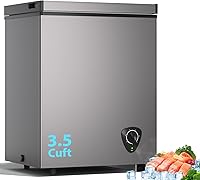
WANAI Black Chest Freezer
The WANAI model has 3.5 cu ft of capacity and outside dimensions of 20.7 x 16.3 x 29.5 in. Its removable basket gives smaller, frequently used items a place near the top.
The thermostat has 7 settings. WANAI describes levels 1–2 as 32°F to 50°F for drinks and fruit, and levels 3–7 as -11.2°F to 32°F for meat and seafood.
This is a possible fit if your plan is modest and the cabinet dimensions work for your location. It uses manual defrost and has a drain hole for water removal.
WANAI says to leave the freezer upright for at least 24 hours before use.
DEMULLER Chest Freezer Small Deep Freeezer
This white DEMULLER model has 3.5 cu ft of capacity and outside dimensions of 20.7 x 16.5 x 29.5 in. Its digital control is described as accurate to 1°F, and the temperature range is -15°F to 41°F.
Two hanging wire baskets help keep smaller foods within reach. The top-open door can remain open from 45 to 75 degrees, and the unit has manual defrost with side drain holes.
The temperature display shows the setting, so it should not be treated as a separate measurement of the food's temperature. DEMULLER recommends leaving the freezer upright for 24 hours before use.
DEMULLER Deep Freezer Chest 3.5 Cubic Feet
The black DEMULLER model also has 3.5 cu ft of capacity, with outside dimensions of 17 x 21 x 30 in. Its electronic control has a digital display and a stated temperature range of -15°F to 41°F.
The manufacturer describes the display as showing the set temperature. Its product information also gives interior dimensions of 16.5 x 12 x 24.1 in, which may help if you need to fit a particular container.
It includes a removable basket and a drain hole, and it uses manual defrost. Check that the listed outside dimensions and interior measurements suit both your installation spot and planned food packages.
How can you keep a small chest freezer organized?
Keep a compact freezer usable with simple groups and an inventory. When items are easy to identify, you can find what you need without shifting the full load.
Set aside a spot for everyday items, a spot for meals and a spot for longer-term packages. Use the basket for items you reach for often, and place less-used food below it.
Label packages with what they contain and when you froze them. Keep a short list on the door or in your phone, then remove items as you use them.
Use packages that stack safely and fit the cabinet. Before freezing a new container, check that it will fit through the opening and leave space for other items you need to retrieve.
Avoid treating the bottom of the freezer as a place to forget food. A simple rotation rule helps: move older packages toward the top when you add new ones.
What should you check before buying?
Confirm capacity, dimensions, access and operating conditions before choosing a compact chest freezer. These checks help prevent a cabinet that is too small, awkward to place or hard to use.
- Write down your peak food load. Include groceries already in the freezer, planned meals and occasional bulk items.
- Measure the installation area. Check the floor, lid clearance, access to the plug and space to stand.
- Measure the delivery route. Check doors, turns and hallways against the cabinet dimensions.
- Read the setup instructions. Follow the model's guidance about placement, leveling and clearance.
- Check the storage layout. See whether the basket and interior shape suit the packages you plan to keep.
- Review maintenance access. Make sure the drain is reachable and account for manual defrost if the model requires it.
- Confirm the location is suitable. Check the manufacturer's approved operating conditions for the room or garage.
Is a 4 cu ft chest freezer the right choice for you?
Choose a 4 cu ft chest freezer if a short inventory of your busiest food load fits the space and you can place the cabinet where its lid, plug and drain remain accessible. Choose a smaller model when your list is brief and floor space is tight; look at a larger capacity when bulk groceries or regular batch cooking exceed that plan.
Measure the exact model before you buy, because capacity does not determine its footprint or interior shape. For nearby compact options, compare our best compact chest freezer guide.
Frequently asked questions
Is a 4 cu ft chest freezer big enough?
A 4 cu ft chest freezer can be enough for modest grocery overflow, frozen meals or a small reserve of meat and vegetables. Whether it fits depends on package sizes and how much food you already keep frozen.
Estimate your busiest load, then leave room to reach and sort items.
How much floor space does a 4 cu ft chest freezer need?
There is no single footprint for every 4 cu ft freezer, so compare the exact outside width, depth and height for the model you want. Add the clearances in its manual, room for the lid to open, and space to stand while loading.
Measure the route to the location too.
Is a 3.5 cu ft freezer close enough to 4 cu ft?
A 3.5 cu ft model is a practical alternative if its actual usable space meets your plan. The difference is modest on paper, but package shapes, baskets and interior layout affect what fits.
Compare those details with your food inventory instead of assuming every cabinet uses its volume the same way.
What should I store in a small chest freezer?
Use a small chest freezer for foods you expect to reach regularly, such as frozen meals, meat portions, vegetables or ice cream. Keep a written or digital inventory and group similar items together so food at the bottom does not get forgotten.
Leave room to add your next planned grocery load.
Can a 4 cu ft chest freezer go in a garage?
A small capacity does not make a freezer suitable for every garage. Check the specific model's approved operating conditions and the manual before choosing an unheated or hot location.
Also make sure the floor is level and the freezer has the required ventilation space.